Every Parent Wants the Best for Their Child
Every parent wants to give their child the best possible start in life.
We carefully choose schools.
We encourage reading.
We enrol them in sports.
We celebrate good grades.
We invest thousands of pounds in activities that we believe will help them succeed.
Yet, despite all of this effort, many families unknowingly overlook one of the most valuable life skills their children will ever need.
Money.
Not because parents don't care.
But because many assume that financial education is something their children will eventually learn elsewhere.
Usually, at school.
It sounds reasonable.
After all, schools teach mathematics, science, history, languages and technology.
Why wouldn't they teach children how money works?
The reality is more complicated.
Schools play an important role in education.
Teachers work incredibly hard to prepare children for adult life.
However, when it comes to financial behaviour, schools can only do so much.
The habits that shape a child's relationship with money are rarely formed inside a classroom.
They are built around the dinner table.
During shopping trips.
While saving for a toy.
When parents say "not today."
When children learn that waiting can be more rewarding than buying immediately.
These ordinary moments become extraordinary lessons.
And no curriculum can fully replace them.
The Invisible Subject
Imagine asking a parent the following question:
"How many hours will your child spend learning mathematics before leaving school?"
Most people would answer:
Thousands.
Now ask another question.
"How many hours will your child spend learning how to budget, save, delay gratification, avoid impulse buying or understand debt?"
Most parents simply don't know.
Financial education often receives far less attention than other essential subjects.
In many countries, it appears only briefly within mathematics, economics or citizenship lessons.
Some children receive excellent financial education at school.
Others receive almost none.
Even where financial education exists, teachers face an impossible challenge.
They have limited classroom time.
They teach dozens of pupils simultaneously.
They follow a national curriculum.
Their goal is to educate an entire class.
Parents, on the other hand, educate one child.
Every single day.
That difference matters.
Because financial education is not simply about knowledge.
It is about behaviour.
Knowing that saving money is important is useful.
Actually choosing to save every week is something completely different.
Children don't develop those habits by memorising definitions.
They develop them by watching the adults around them.
What the Research Actually Says
This isn't simply an opinion.
Recent international research paints a remarkably consistent picture.
One of the most comprehensive studies ever conducted on financial literacy among teenagers comes from the OECD's Programme for International Student Assessment (PISA 2022), published in 2024.
Researchers examined how 15-year-olds from multiple countries understand money, spending, saving and financial decision-making.
One finding stands out.
Students who regularly discuss spending decisions, shopping and money choices with their parents tend to achieve higher levels of financial literacy than students who rarely—or never—have these conversations. Importantly, this association remained even after accounting for factors such as socio-economic background, gender and immigrant status.
The report also found that around three out of every four students discuss money with their parents at least once a month.
That matters.
Because these conversations are not formal lessons.
They happen naturally.
While buying groceries.
Choosing between two products.
Saving for something special.
Talking about pocket money.
Or deciding whether something is really worth buying.
The researchers are careful not to claim that these conversations alone cause higher financial literacy. However, they do conclude that family interactions are closely associated with stronger financial understanding and should be considered alongside school education and personal experience.
In other words:
Schools matter.
But so do parents.
Perhaps more than many families realise.
Figure 1. Frequency of discussing money matters with parents
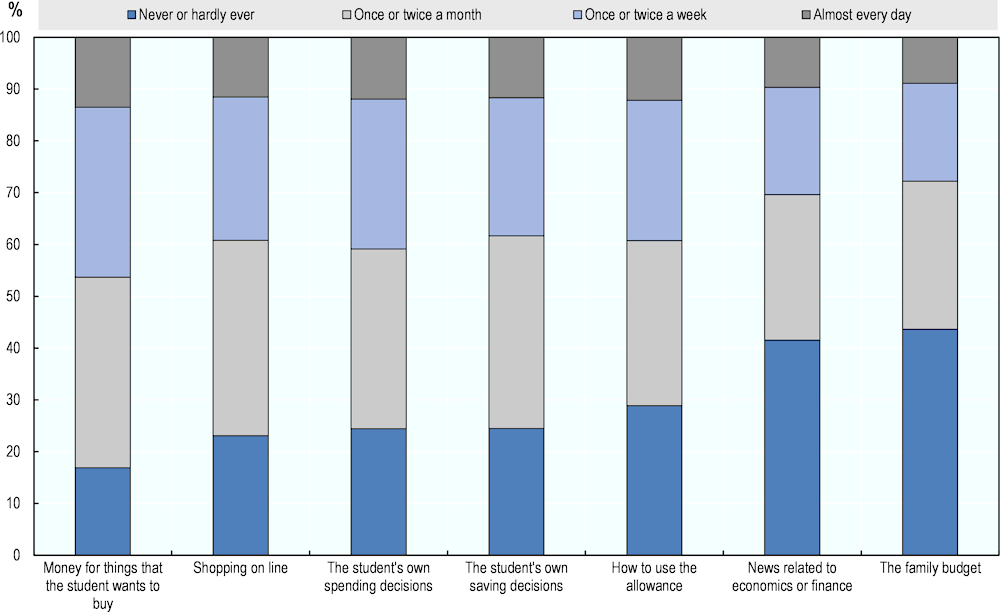
Caption:
Figure 1. Frequency of discussing money matters with parents. Percentage of students who reported discussing different financial topics with their parents. OECD average.
Source: OECD (2024), PISA 2022 Results (Volume IV): Students and Money – Financial Literacy Skills for the 21st Century, Figure IV.4.1.
The OECD found that conversations about money already form part of everyday family life. Around four in five students discuss purchases they would like to make with their parents at least once a month, while discussions about spending decisions, saving and pocket money are also common. These everyday conversations provide valuable opportunities for children to observe how financial decisions are made in real life.
Why Children Learn More Than We Think
Children are constantly learning.
Even when nobody believes they are.
Long before they understand interest rates or bank accounts, they observe something far more powerful.
Behaviour.
They notice whether parents compare prices.
They notice whether purchases are planned or impulsive.
They notice whether saving happens before spending.
They notice how adults react when unexpected expenses appear.
Without saying a single word, parents teach lessons every day.
Some of those lessons build patience.
Others build discipline.
Others teach children that happiness comes from buying immediately.
The important point is this:
Children rarely learn their financial attitudes from a textbook.
They learn them from life.
And life happens at home.
Schools Matter. Parents Matter More.
At this point, it's important to make something clear.
This isn't an argument against schools.
Teachers play an extraordinary role in children's lives.
Schools introduce concepts, encourage critical thinking and create opportunities to learn.
But expecting schools to carry the entire responsibility for financial education places an impossible burden on an already overloaded education system.
Financial literacy isn't like geography or chemistry.
It isn't a subject that can simply be taught for one hour every Tuesday morning.
It's a behaviour.
And behaviours are built through repetition.
Not lectures.
This is exactly why so many researchers argue that financial education should be a partnership between schools and families rather than the responsibility of either one alone.
Figure 2. Financial literacy performance by frequency of discussing money matters with parents

Caption:
Figure 2. Financial literacy performance by frequency of discussing money matters with parents. OECD average.
Source: OECD (2024), PISA 2022 Results (Volume IV): Students and Money – Financial Literacy Skills for the 21st Century, Figure IV.4.2
The OECD found a clear relationship between family conversations about money and students' financial literacy. Interestingly, the highest scores were achieved by students who discussed money with their parents once or twice a month, rather than every day. The OECD emphasises that this is an association rather than proof of causation, but the findings suggest that regular, meaningful conversations may be more beneficial than frequent or repetitive discussions.
Four Financial Habits Every Child Should Learn at Home
Children don't need investment portfolios.
They don't need to understand inflation at the age of six.
They don't need to know how mortgages work.
What they need are habits.
Small habits.
Repeated thousands of times.
Those habits become character.
And eventually, character becomes financial behaviour.
1. Learning to Wait
Perhaps the most valuable financial lesson any child can learn has nothing to do with money.
It is learning to wait.
In today's world, almost everything is available instantly.
One click.
Next-day delivery.
Tap a phone.
Buy now.
Children rarely experience delayed gratification unless adults intentionally create those opportunities.
Saving for a toy teaches something no lecture ever could.
It teaches that good things are often worth waiting for.
2. Understanding That Money Is Earned
Many children grow up believing money simply appears.
A card touches a payment terminal.
A phone makes a beep.
The shopping arrives.
The connection between effort and money becomes invisible.
Parents can reconnect those two ideas through simple experiences.
Age-appropriate chores.
Helping around the house.
Working towards rewards.
Not because children should be "paid for everything".
But because they begin to understand that value is created through effort.
3. Distinguishing Needs from Wants
One of the most powerful conversations parents can have is surprisingly simple.
Ask:
"Do we need this, or do we simply want it?"
That single question develops judgement.
Advertising encourages children to buy emotionally.
Parents can teach them to think rationally.
Those tiny conversations repeated over years may become some of the most valuable financial lessons they ever receive.
4. Talking About Money Without Fear
For many adults, money was a forbidden subject growing up.
Parents avoided discussing bills.
Savings.
Budgets.
Debt.
Investments.
As a result, many children entered adulthood without understanding even the basics of personal finance.
The OECD's PISA 2022 research suggests something remarkably simple.
Children who regularly discuss spending decisions with their parents generally demonstrate stronger financial literacy than those who never have those conversations. The relationship remains even after accounting for differences such as socio-economic background, gender and immigrant status, although the OECD is careful to note that this is an association rather than proof of cause and effect.
Money doesn't need to become a stressful topic.
It simply needs to become a normal conversation.
Figure 3. Financial literacy performance by students' autonomy in spending decisions
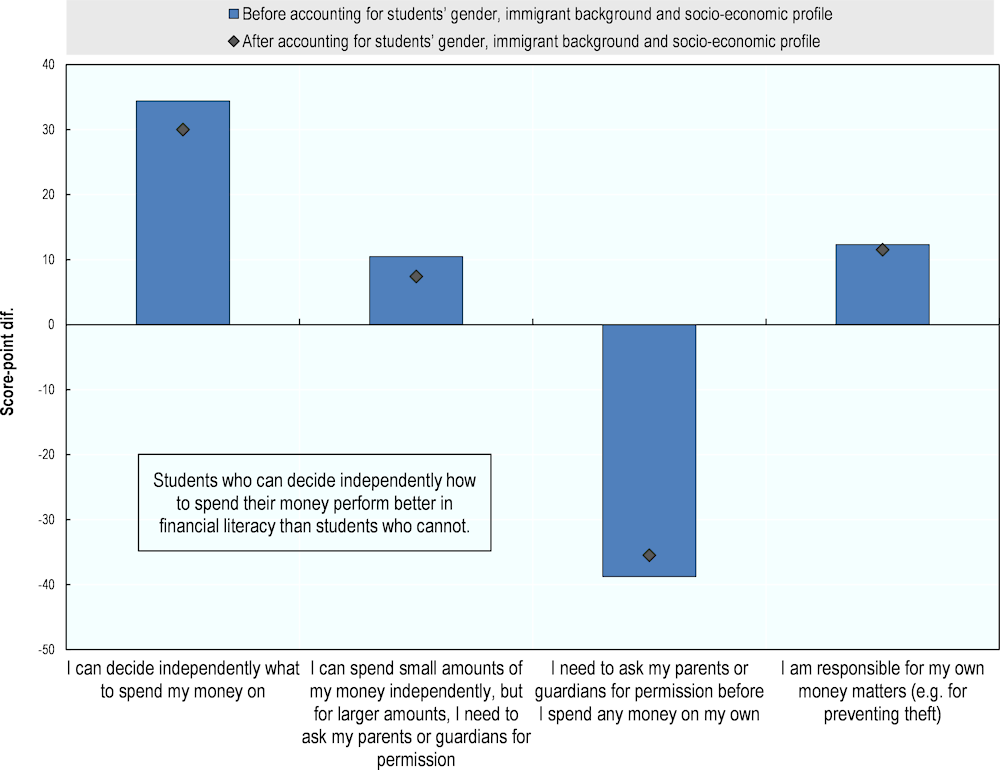
Caption:
Figure 3. Financial literacy performance by students' autonomy in spending decisions. Score-point difference between students who agree with and those who do not agree with each statement. OECD average.
Source: OECD (2024), Figure IV.4.3.
The OECD also found that children who are given appropriate autonomy to manage their own money tend to achieve higher financial literacy scores. Allowing children to make age-appropriate financial decisions—while still providing guidance—may help them build confidence, responsibility and sound judgement.
The Most Important Classroom Is Probably Your Kitchen Table
Professor David Whitebread, a developmental psychologist at the University of Cambridge, has argued that many important self-regulation skills begin developing during early childhood. Skills such as planning, patience, self-control and decision-making underpin many later financial behaviours, even if children are not yet learning about bank accounts or investing. These foundations are built through everyday experiences with parents and caregivers, not only through formal lessons.
That changes the question completely.
Instead of asking:
"When will school teach my child about money?"
Perhaps parents should ask:
"What am I teaching my child about money today?"
Because children are always learning.
Even when we aren't teaching.
The Responsibility We Rarely Talk About
Modern parents face enormous pressure.
They work longer hours.
Technology competes constantly for children's attention.
Schools are expected to teach more subjects than ever before.
It's understandable that many families hope financial education will simply happen somewhere along the way.
But the evidence suggests something different.
Children develop financial habits through hundreds of ordinary experiences.
Watching parents compare prices.
Saving for birthdays.
Waiting before making purchases.
Planning family holidays.
Discussing why something is affordable—or why it isn't.
No school timetable can recreate those moments.
Only families can.
A Better Partnership
The real question isn't:
Should schools teach financial education?
Of course they should.
The better question is:
Should parents expect schools to do it alone?
Probably not.
The strongest evidence points towards collaboration.
Schools provide knowledge.
Parents provide daily practice.
Technology can reinforce both.
When those three work together, children receive something far more valuable than information.
They develop lifelong habits.
Final Thoughts
Children probably won't remember every maths lesson they had at school.
They probably won't remember every worksheet about budgeting either.
But they will remember watching their parents save for something important.
They will remember hearing:
"Let's wait another week."
They will remember comparing prices in the supermarket.
They will remember earning their first reward through effort.
They will remember the conversations around the dinner table.
Because financial education is not simply a school subject.
It is a family culture.
Schools can introduce financial literacy.
Parents bring it to life.
And when both work together, children gain something that may benefit them for the rest of their lives.
References
- OECD (2024), PISA 2022 Results (Volume IV): Students and Money – Financial Literacy Skills for the 21st Century, OECD Publishing, Paris.
- OECD (2024), Shaping Students' Financial Literacy, PISA in Focus.
- Whitebread, D. and Bingham, S. (2013), Habit Formation and Learning in Young Children, University of Cambridge.
- LeBaron-Black, S. et al., research on family financial socialisation, parental modelling and money conversations.