PiggyWorld connecting physical cash with digital money learning for children
Money is becoming increasingly difficult for children to see.
Adults can buy groceries with a contactless card, pay household bills automatically and send money through an app without handling a single coin or banknote. To a child watching from the outside, it may appear that a card, phone or watch can produce whatever the family needs.
The transaction is visible. The money leaving the account is not.
This creates a new challenge for parents. Children need to understand the value of money, but many of the physical experiences that once made money easier to understand are disappearing from everyday life.
Cash gives children something they can touch, count and physically exchange. Digital money reflects the financial world they are growing up in, but it can feel abstract and unlimited if it is introduced without explanation.
So, which helps children learn better: cash or digital money?
The answer is not as simple as choosing one and rejecting the other.
Cash helps children see and feel money. Digital tools help them understand the financial world they actually live in. The strongest learning experience combines both.
Why Money Is Becoming Invisible to Children
Think about what a young child sees during an ordinary shopping trip.
A parent fills a basket, approaches the checkout, taps a card and leaves with the shopping. There may be no discussion about price, no coins to count and no change to check.
From the child’s perspective, the card appears to have paid for everything instantly. They cannot see the balance before the purchase, the amount leaving the account or the other things the family may now be unable to buy with that money.
The same invisibility appears elsewhere:
- Household bills are paid automatically.
- Online orders arrive days after a button was pressed.
- Pocket money may be transferred directly into an account.
- Games use gems, coins, points and other virtual currencies.
- Subscriptions renew without a new payment decision being made.
- In-app purchases may require only a tap or password.
- Children see adults using cards and phones far more often than notes and coins.
This does not mean digital payments are harmful. They are convenient, fast and an essential part of modern financial life.
However, convenience can remove some of the natural pauses that previously helped people notice they were spending money.
MoneyHelper, the consumer service provided by the Money and Pensions Service, advises parents to explain that a card, phone or watch is using real money from an account. Without that explanation, younger children may believe that cashless payments allow adults to obtain things for free.
The scale of digital payment use shows why this lesson matters. UK-issued debit and credit cards were used for 31.4 billion transactions in 2024, with a total value exceeding £1 trillion, according to UK Finance.
Children are not preparing for a distant digital future. They are already surrounded by it.
Children’s Pocket Money Is Becoming Digital Too
The transition from cash to digital money begins earlier than many parents may expect.
Research commissioned by the Money and Pensions Service found that 68% of seven-year-olds who received pocket money received all of it in cash. By age eleven, this had fallen to 46%.
Percentage of children receiving all their pocket money in cash falls from 68% at age 7 to 46% at age 11
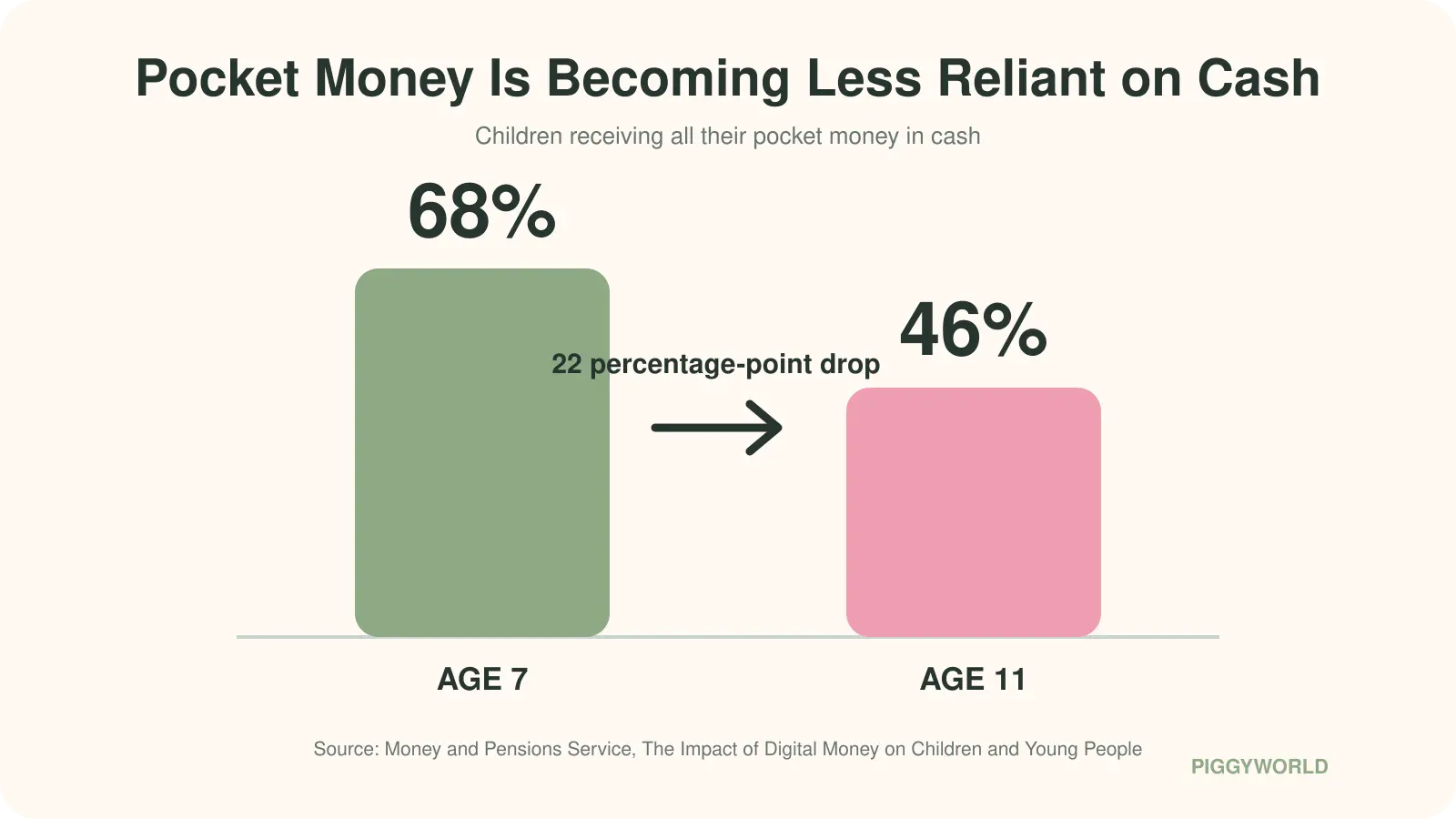
Across children aged 7 to 17, only 57% received all their pocket money in cash.
This means a growing number of children are encountering account balances and digital transfers while they are still developing a basic understanding of what money represents.
The Money and Pensions Service review of digital money and children explains that digital money may offer useful learning opportunities, including access to balances and spending information. However, the research also highlights the risk that reduced use of cash can limit children’s practical experience of handling and calculating money.
The question is therefore not whether children should use digital money. Most eventually will.
The important question is whether they understand it.
What Does Physical Cash Teach Children?
Cash has characteristics that make it especially useful during the earliest stages of financial learning.
Cash makes quantity visible
Five £1 coins visibly represent more money than one £1 coin.
A child can place the coins in a row, divide them into groups or compare them with a price. This creates a direct relationship between the number they see and the amount they possess.
A digital balance also shows quantity, but the child must understand what the number on the screen represents. Cash provides the physical experience that can help give those numbers meaning.
Cash can be counted
Coins and notes allow children to practise:
- Recognising different denominations
- Counting
- Adding and subtracting
- Grouping money
- Calculating change
- Comparing amounts with prices
- Dividing money between saving and spending
These are mathematical skills, but they are also practical financial skills.
A child who counts seven £1 coins towards a £10 toy can see both what they have and what is missing. The remaining £3 is not merely a number in an exercise book. It stands between them and something they want.
Cash creates a visible limit
If a child takes £5 to a shop, they cannot spend £7.
The limit is physically present. Once the money has been used, it is no longer in their hand or purse.
This can make budgeting easier to understand. The child does not need to remember an account balance or interpret an app. They can see exactly how much remains.
Spending cash creates a physical consequence
Handing over money feels different from tapping a card.
The child watches the coins leave their possession and receives the product in exchange. This makes the transaction more concrete:
I had the money. I chose to buy this. Now I have the product, but I no longer have the money.
That exchange introduces opportunity cost. Money used for one purpose cannot also be used for another.
Cash encourages a pause
Cash normally has to be counted and handed over. Even a brief pause can create a moment to reconsider a decision.
Do I have enough?
Is this what I want most?
How much will I have left?
Digital payments can also involve thoughtful decisions, but the payment process itself is often designed to remove friction. Children therefore need adults to reintroduce the pause deliberately.
Cash can make saving tangible
A child who adds money to a piggy bank can hear and feel their savings growing.
Each coin is small, but repeated contributions create a visible or audible result. This helps demonstrate one of the most important principles of saving: progress does not have to happen all at once.
A child may begin with £2, add £1 each week and eventually reach a £10 target. The amounts are modest, but the pattern is powerful:
Save regularly. Follow the progress. Wait. Reach the goal.
The Limitations of Teaching Children Only with Cash
Cash is a valuable teaching tool, but it cannot provide a complete financial education by itself.
Cash no longer reflects every transaction
Children will eventually need to understand:
- Debit cards
- Bank transfers
- Contactless payments
- Mobile wallets
- Direct debits
- Subscriptions
- Online shopping
- In-app purchases
- Digital account balances
A child who understands only physical money may find it difficult to recognise that these activities all involve real financial consequences.
Cash does not automatically create a record
Unless every purchase is written down, cash does not show where the money went.
Digital accounts can provide transaction histories, categories and notifications. These can help older children look back at their decisions and identify patterns.
A closed money box can hide progress
A traditional piggy bank stores money, but children may not know the exact balance without emptying and counting it.
This can make a distant savings goal harder to follow. Visible progress is especially important for younger children, who may find it difficult to stay motivated by a reward that is weeks or months away.
Cash can become disconnected from family banking
A child may save coins while seeing their parents use digital payments for almost everything. If nobody explains the connection, the child may start to think of cash as “children’s money” and cards as a separate, unlimited system used by adults.
Children need to understand that physical and digital money are different forms of the same limited resource.
What Can Digital Money Teach Children?
Digital money can support valuable learning when children are given age-appropriate access, clear boundaries and regular guidance.
Digital balances reflect modern financial life
Most children will eventually receive money, save, shop and pay bills digitally.
Introducing account balances gradually helps them understand that money does not stop being real when it disappears from view.
A balance of £20 represents the same spending power whether it appears as notes in a wallet or as numbers in an account.
Digital tools can show exact progress
A digital goal can display:
- The current balance
- The target amount
- The percentage completed
- The amount still needed
- Previous contributions
- The time taken to reach the goal
This can make progress more understandable and motivating.
Instead of hearing, “You still need to save more”, a child might see that they have reached £15 of a £20 target. The remaining distance becomes clear and achievable.
Transaction histories support reflection
A spending record allows parents and children to review previous decisions.
The purpose should not be to criticise every purchase. It should be to help the child notice patterns and think about outcomes.
Parents might ask:
- What did you spend the most money on?
- Which purchase made you happiest?
- Did anything cost more than you expected?
- Is there anything you would choose differently next time?
- How did that purchase affect your savings goal?
Looking backwards can improve future decisions.
Digital money can support parental guidance
Depending on the service, parents may be able to set limits, receive notifications or approve transactions.
These controls can create a safer environment in which children practise making decisions before gaining complete financial independence.
The objective is not permanent surveillance. It is gradual responsibility.
Digital tools can connect actions with outcomes
Tasks, goals and rewards can help children understand that money is connected with effort, planning and choices.
This does not mean paying children for every household responsibility. Families may decide that some tasks are part of contributing to family life, while selected additional tasks provide an opportunity to earn.
The important point is that the system remains clear and consistent.
The Risks of Introducing Digital Spending Without Preparation
Digital money is not automatically educational simply because it appears in a child-friendly app.
Technology can display useful information, but children still need experience, explanation and parental involvement.
Digital spending can feel less real
A child may understand that £5 in cash is limited because they can hold it. A £5 digital balance may feel more like a score in a game.
This becomes particularly confusing when games use virtual currencies.
A child might buy 500 gems for £4.99 and then use 300 gems on an item. The real price has been converted twice:
- Pounds into virtual currency.
- Virtual currency into a digital object.
Each conversion makes the financial consequence less visible.
Fast payments reduce thinking time
Contactless and in-app payments are intentionally convenient.
That convenience is useful for adults, but children may need more time to consider what they are buying. If the process feels effortless, the decision may also feel insignificant.
Parents can create a simple pause before digital purchases:
- What are you buying?
- What does it cost in pounds?
- How much will remain afterwards?
- Do you want it now, or would you prefer to wait?
- Will it affect your existing savings goal?
Online environments can encourage spending
Online platforms do not always present purchasing decisions neutrally.
Limited-time offers, countdowns, rewards, virtual currencies and repeated prompts can make children feel that they must act quickly.
Ofcom reported in 2025 that 58% of children aged 8 to 17 had spent money online during the previous month, including through gaming, social media and video-sharing platforms. Among children who made relevant purchases:
- 32% regretted purchases made in games
- 43% regretted purchases made on social media
- 42% found it unclear what they were buying in games
Ofcom’s research into children’s online spending also found a difference between what children and parents reported: 58% of children said they had recently made an online purchase, compared with 53% of parents reporting that their child had done so.
This does not mean children should never spend money online. It shows why understanding, communication and parental controls matter.
Digital access can be mistaken for unlimited money
A card may continue working after one purchase, unlike a five-pound note that has been handed over.
Children need to understand that access to a payment method is not the same as having unlimited money. Every payment reduces a balance or creates an amount that must later be repaid.
Parental controls cannot replace education
Controls can prevent some unwanted purchases, but they do not teach the child why a decision may be unwise.
A child who is always prevented from making choices may have fewer opportunities to practise. A child who has unrestricted access may face consequences they are not ready to manage.
The goal is controlled independence: safe opportunities to choose, make small mistakes, reflect and try again.
Cash vs Digital Money for Children: A Practical Comparison
Learning are a Physical cash Digital money Combined approach Touching and counting money Excellent Limited Uses cash to explain the value behind the screen Understanding that money is limited Highly visible Requires explanation Reinforces limits physically and digitally Following an exact balance Requires counting Immediate Allows the child to verify one against the other Seeing savings progress Visual if the container is clear Can show exact progress Makes the goal tangible and measurable Learning modern payment methods Limited Essential Prepares children gradually Reviewing previous spending Must be recorded manually Transaction history may help Combines experience with reflection Understanding online purchases Limited Relevant but potentially abstract Connects online prices with real money Practising independent decisions Useful for small purchases Useful with safeguards Responsibility increases with age Parental involvement Conversation-ledMay include controls and notifications Combines guidance with appropriate technology Risk of impulsive spending Naturally limited by available cash Can be higher without boundaries Uses limits, pauses and discussion
Neither method is universally better.
Cash is particularly effective for introducing quantity, exchange and limits. Digital money becomes increasingly important as children grow older and begin encountering online spending, cards and bank accounts.
The strongest approach uses each method for what it teaches best.
Comparison of how cash and digital money help children learn

What Should Children Learn at Different Ages?
Every child develops differently, so age ranges should be treated as guidance rather than strict rules.
Ages 3–5: Discovering what money is
At this stage, the objective is familiarity rather than financial independence.
Children can begin to:
- Recognise that money is used to buy things.
- Identify and sort different coins.
- Count small numbers of coins with an adult.
- Put money into a piggy bank.
- Choose between two inexpensive options.
- Understand that an item must be paid for before leaving a shop.
- Watch an adult use cash and receive change.
Digital payments can be explained in very simple terms:
“When I tap this card, money leaves our bank account to pay for the shopping.”
Children should not need to manage a digital account independently. They are learning that money exists, that it is limited and that purchases involve an exchange.
Loose coins can present a choking risk, so all physical-money activities should be supervised appropriately.
Ages 5–7: Counting and making simple choices
Children can begin to:
- Count towards a short-term goal.
- Compare simple prices.
- Understand “enough” and “not enough”.
- Save small amounts regularly.
- Choose whether to spend now or wait.
- Use a limited amount of cash during a supervised purchase.
- See a digital balance with an adult.
- Connect a cash amount with the same number on a screen.
MoneyHelper suggests that children in this age group can learn through ordinary experiences such as playing shop, helping with shopping and saving towards something small. Its learning-about-money guidance by age emphasises practical, age-appropriate participation.
A first savings goal should be achievable. Reaching £5 or £10 can teach more than struggling indefinitely towards an expensive toy.
Ages 8–10: Planning and reflecting
Children may be ready to:
- Manage a regular, modest amount of pocket money.
- Divide money between saving and spending.
- Work towards a longer goal.
- Compare value rather than simply price.
- Review a simple transaction history.
- Understand that online purchases use real money.
- Learn how in-app purchases work.
- Discuss advertising and spending pressure.
- Use a supervised child-appropriate digital tool.
- Make small decisions and reflect on mistakes.
Parents can begin asking more detailed questions.
Instead of saying, “Don’t waste your money”, ask:
“If you buy this today, how much will remain for your goal?”
This allows the child to participate in the calculation and decision.
Ages 11–12: Preparing for greater independence
Children can gradually learn about:
- Bank accounts and cards
- Contactless payments
- PIN security
- Online shopping
- Subscriptions and recurring payments
- Scams and fraud
- Virtual currencies
- Needs and wants
- Short- and long-term savings goals
- The difference between debit and credit
- The importance of checking transactions
The aim is not to make an eleven-year-old responsible for adult financial decisions. It is to reduce the shock of independence by building understanding beforehand.
Parents should continue to agree boundaries and discuss online spending. Access should expand alongside the child’s judgement, not merely because a particular birthday has been reached.
Teenagers: Moving from guidance towards independence
Teenagers can take more responsibility for:
- Budgeting over a week or month
- Managing travel and social spending
- Reading payslips
- Understanding interest
- Recognising borrowing and debt
- Comparing financial products
- Protecting personal and banking information
- Identifying scams
- Managing subscriptions
- Saving for larger goals
Digital money will be central at this stage, but the lessons first learned through physical cash remain relevant.
A balance is still limited. Spending still involves trade-offs. Small amounts still accumulate. Waiting can still lead to a better outcome.
The format changes. The principles do not.
How Parents Can Combine Cash and Digital Money
Parents do not need a complicated financial curriculum. Ordinary family activities can teach many of the essential lessons.
Start with something tangible
Allow younger children to handle and count cash with supervision.
If they receive money for a birthday or special occasion, count it together before deciding what to do with it.
Give every digital number a meaning
Do not assume a child understands a balance simply because they can read it.
If a screen shows £12, compare it with:
- Twelve £1 coins
- The price of something familiar
- The child’s savings target
- What would remain after a possible purchase
This helps connect the number with real value.
Use one goal across both worlds
A child might keep some coins physically while following the complete target digitally.
The objective is not to count the same money twice. It is to make the relationship between the tangible money and the recorded progress clear.
Involve children in shopping
Give the child a small budget and a genuine choice.
For example:
“We have £4 to choose fruit for the week. Which combination can we buy without going over the budget?”
The child can inspect prices, compare options and see the result at the checkout.
Explain what happens when you tap a card
A simple running explanation can make invisible transactions easier to understand:
“The shopping costs £26. When I tap the card, £26 leaves our account. That means we have £26 less available for other things.”
MoneyHelper provides further practical suggestions in its guide to explaining digital money to children.
Convert virtual prices back into pounds
Before approving an in-game purchase, establish its real cost.
Ask the child to calculate or discuss:
- How many pounds the virtual currency costs.
- What the digital item costs in real money.
- Whether the item can be resold or refunded.
- What else could be bought with the same amount.
- Whether they would still want it after waiting 24 hours.
This makes the decision less abstract.
Create a pause before digital purchases
Families can introduce a simple rule:
No non-essential online purchase is made immediately.
The waiting period can vary according to the child’s age and the amount involved. Even a short delay can reduce impulsive decisions.
Allow safe, small mistakes
Financial education should not require every decision to be perfect.
If a child spends a small amount and later regrets it, that experience may teach more than repeated warnings. The role of the adult is to keep the consequence safe and help the child reflect without shame.
Useful questions include:
- Are you satisfied with what you bought?
- Did it provide what you expected?
- Would you make the same decision again?
- What will you do differently next time?
Model the behaviour you want to teach
Children notice how adults talk about and use money.
Parents can make useful behaviour visible by saying:
- “I’m comparing these prices.”
- “I’m going to wait before buying this.”
- “This payment is coming from our weekly budget.”
- “I cancelled this subscription because we no longer use it.”
- “I’m saving a small amount each month for something important.”
These small explanations reveal the thinking that digital payments normally hide.
How PiggyWorld Connects Physical and Digital Learning
Children should not have to choose between a traditional childhood experience and the financial world they are growing up in.
PiggyWorld begins with something familiar and tangible: a physical piggy bank that belongs to the child.
It then extends that experience through age-appropriate technology, helping families turn saving into a visible and repeatable journey.
Children can work towards goals, follow their progress and connect agreed tasks and rewards with the things they want to achieve. Parents remain involved in setting appropriate boundaries and guiding the experience.
The physical piggy bank provides an emotional and tangible connection with saving. The connected experience helps make progress easier to follow and gives families a structure for conversations about effort, reward, patience and choice.
The purpose is not to replace coins with a screen or to make young children behave like adult banking customers.
It is to build a bridge.
A child can begin with the simple experience of saving something real, while gradually learning that digital money is equally real, equally limited and equally connected with decisions.
PiggyWorld is designed around a straightforward principle:
Technology should make money easier for children to understand, not easier to ignore.
Frequently Asked Questions
Is cash or digital money better for teaching children?
Cash is often more effective for introducing quantity, counting, exchange and limits because children can physically see what they have. Digital money is important for teaching children about balances, cards, online spending and the financial environment they will use as they grow.
The most complete education combines both.
Should children learn with cash before using a card?
For many younger children, beginning with cash can help build a concrete understanding of value. Once the child understands that money is limited and that spending reduces what remains, parents can gradually connect those ideas with cards and digital balances.
There is no universal age or sequence, but the child should understand what a digital payment represents before being given significant independence.
Does using cash help children understand the value of money?
Cash can make value easier to see because it can be counted, grouped and physically exchanged. However, cash alone does not teach every aspect of money management. Parents should also explain digital payments and involve children in age-appropriate financial decisions.
Why can digital money be confusing for children?
Digital money is represented by numbers, cards, apps or virtual currencies rather than physical objects. Payments can happen quickly, and the reduction in the balance may not be immediately visible.
Children may therefore misunderstand how much they have spent or believe that a card provides unlimited access to money.
Are children more likely to overspend digitally?
Digital purchasing can reduce the physical and emotional friction associated with handing over cash. Online services may also use virtual currencies, countdowns and other design features that encourage immediate decisions.
This does not mean every child will overspend digitally. Clear limits, parental controls, real-price explanations and waiting periods can reduce the risk.
How can I explain contactless payments to a young child?
Explain that the card or phone is connected to a bank account where the family’s money is stored. When the card is tapped, the price leaves that account.
You can show the child the receipt and, when appropriate, the transaction in the banking app.
Should pocket money be given in cash or paid into an account?
The right approach depends on the child’s age and experience.
Cash may be more useful when a child is first learning to count and make simple choices. A digital payment can help an older child practise checking a balance and managing modern payment methods.
Some families may find that a combination works best.
How can I teach my child about in-app purchases?
Always translate the virtual price into pounds. Explain what the child will receive, whether it can be refunded and how the purchase will affect their remaining money or savings goal.
Remove automatic purchasing where appropriate and require adult approval before payments.
At what age should children start learning about digital money?
Digital money can be explained as soon as children notice adults using cards or phones to pay. For very young children, the explanation can be simple.
Independent access should come later and develop gradually according to the child’s understanding, maturity and the safeguards available.
Can a piggy bank still be useful when payments are digital?
Yes. A piggy bank gives children a tangible introduction to saving, ownership and delayed gratification. A modern connected piggy bank can also help families link that physical experience with goals, progress and the digital financial world.
Children Need to Understand Both Worlds
Cash and digital money are sometimes presented as competitors.
For children, they should be partners.
Cash makes money tangible. It allows children to touch, count and exchange something real. It demonstrates limits clearly and gives spending a visible consequence.
Digital money prepares children for the way they will receive, save and spend money throughout much of their lives. It can show exact balances, record transactions and make long-term progress easier to follow.
Each method solves a problem the other cannot solve completely.
Children who learn only with cash may be unprepared for invisible payments, online spending and virtual currencies. Children who experience only digital money may miss the physical understanding that makes numbers and balances meaningful.
The strongest financial education connects the two.
It begins with real experiences, develops through regular conversations and gives children increasing responsibility as their understanding grows.
The objective is not merely to teach children how to pay.
It is to help them understand what happens before and after every payment: earning, choosing, waiting, saving, spending and living with the result.
That understanding will matter regardless of whether the payment is made with a coin, a card, a phone or a technology that has not yet been invented.
Help Your Child See the Money Behind Every Payment
PiggyWorld combines the familiarity of a physical piggy bank with an interactive experience designed to make goals, tasks and progress more visible.
It helps families introduce healthy money habits through participation, encouragement and everyday decisions — while creating a bridge between the physical and digital worlds.
Give your child more than somewhere to keep money. Give them a way to understand it.
PiggyWorld. The piggy bank you’ll never have to break.
Sources and Further Reading
- Money and Pensions Service — Literature Review: The Impact of Digital Money on Children and Young People
- Money and Pensions Service — UK Children and Young People’s Financial Wellbeing Survey
- MoneyHelper — Explaining Digital Money to Children
- MoneyHelper — Learning About Money by Age
- MoneyHelper — Pocket Money and Saving
- Ofcom — Children’s Online Spending and Potential Financial Harm
- Ofcom — Online Nation Report 2025
- UK Finance — £1 Trillion Worth of UK Card Transactions in 2024