Giving a child pocket money sounds simple until you try to decide how much to give.
Should a seven-year-old receive £1 or £5 a week? Should a teenager receive a weekly allowance or learn to manage a monthly budget? Should children earn every pound through chores, or should some household responsibilities simply be part of family life?
There is no single amount that is right for every child. A useful allowance depends on the child's age, what they are expected to pay for, the family's circumstances and—most importantly—what the money is intended to teach.
Recent UK data provides helpful benchmarks, but averages are not instructions. The best amount of pocket money is not necessarily the national average or the amount another child receives. It is the smallest regular amount that gives your child meaningful choices, allows safe mistakes and remains sustainable for your family.
This guide explains how much pocket money children receive in the UK, offers practical starting ranges by age and shows how to use an allowance to teach saving, spending, patience and responsibility.
The short answer: how much pocket money should you give?
For many UK families, a reasonable starting point is:
Child's age Suggested starting range Recommended frequency Main learning goal 4–5 No fixed allowance or up to £1 Occasional or weekly Recognising coins, choosing and waiting 6–7 £2.50–£3 Weekly Making a simple spend-or-save decision 8–9 £3–£4 Weekly Saving towards a short-term goal 10–11 £3.50–£5 Weekly Planning several purchases 12–13 £4–£7 Weekly or fortnightly Budgeting and understanding digital money 14–15 £5–£10 Weekly or fortnightly Managing agreed personal expenses 16–17 £7–£15 Weekly, then monthlyLonger-term planning and greater independence
These figures are starting ranges, not rules. Before choosing an amount, decide what the money needs to cover. £10 a week is generous if it is purely for treats, but may be modest if a teenager must also pay for lunches, transport, toiletries or social activities.
If money is tight, a smaller regular allowance can still be educational. A child can learn more from managing £1 consistently than from receiving £10 unpredictably with no guidance.
PiggyWorld principle: Start with an amount your family can maintain, give the child genuine choices and increase both the money and the responsibility gradually.
What is the average pocket money in the UK?
The NatWest Rooster Money Pocket Money Index 2026 analyses activity from more than half a million young users in the UK. It reports that the average regular allowance for children aged 6–17 is £3.94 a week.
That is different from total income. When paid chores, gifts and one-off transfers are included, average weekly income rises to £9.74.
This distinction matters. A headline saying that UK children receive almost £10 a week can make parents feel they are giving too little, even though much of that money may come from birthdays, jobs or occasional payments rather than a fixed allowance.
Average regular weekly pocket money by age
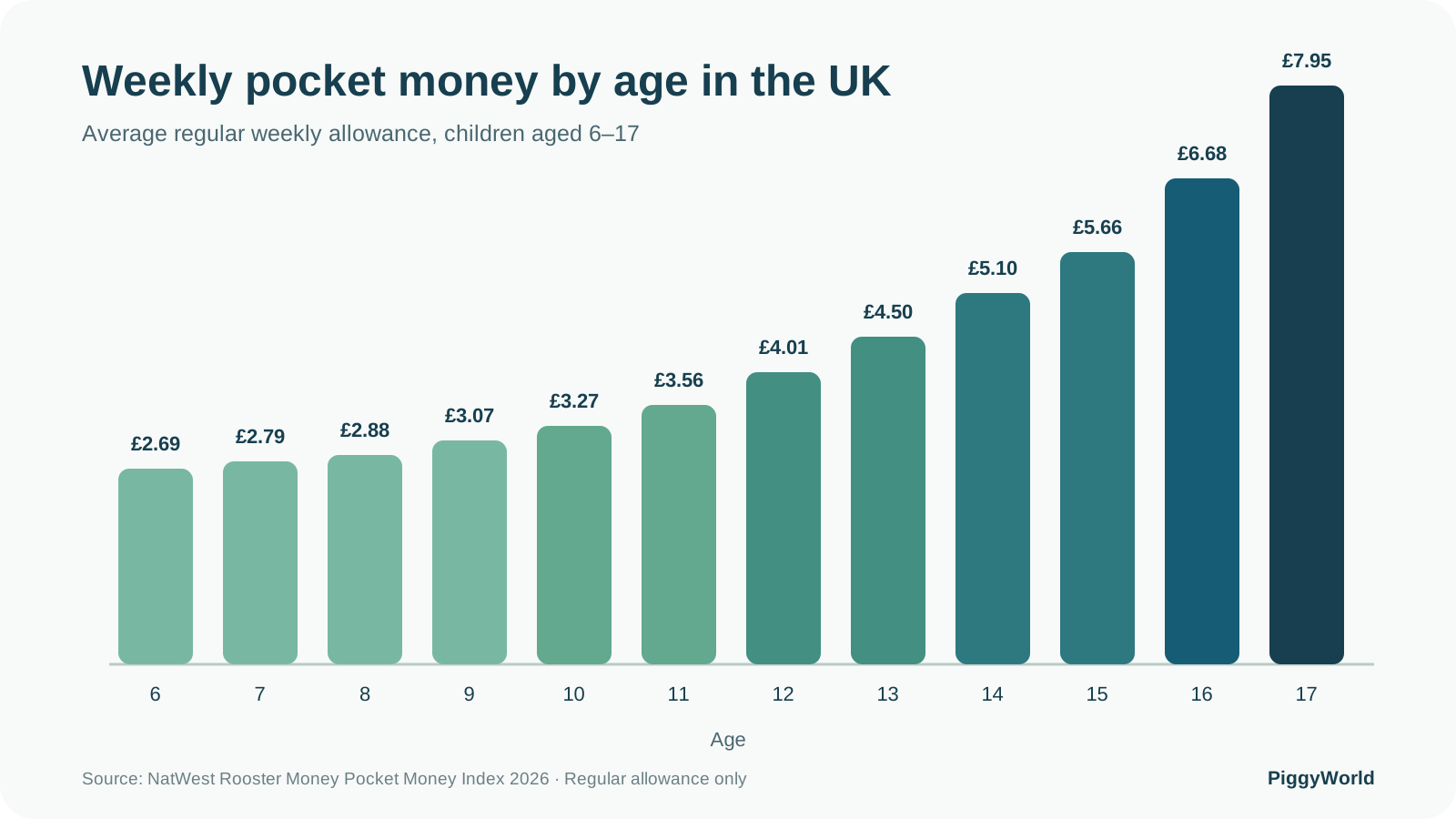
The figures rise gradually with age, rather than jumping dramatically each year. That is a useful model: increase pocket money when a child is ready to manage more responsibility, not simply because another birthday has arrived.
Average does not mean recommended
National figures can help you sense-check an amount, but they cannot account for your family's budget or rules.
Before setting an allowance, answer three questions:
- What can we afford to give consistently? A regular amount is easier to plan around than a larger but unreliable payment.
- What will the child be expected to buy? Define which costs remain the parents' responsibility and which become the child's.
- What skill are we trying to teach next? A six-year-old may need to practise waiting for a toy; a sixteen-year-old may need to budget for a month of social plans.
A practical formula is:
Pocket money = a sustainable family amount + the expenses the child will manage + an age-appropriate opportunity to learn.
The amount should be large enough to create choices but small enough for mistakes to remain safe. If a child can buy everything immediately, there is little reason to plan. If a goal feels impossible, saving may appear pointless.
When should children start receiving pocket money?
There is no compulsory starting age. Readiness matters more than a birthday.
Research commissioned by the Money and Pensions Service into financial capability among children aged four to six found that many children begin developing basic money concepts before they start receiving a regular allowance:
- At around four, children may recognise that coins and notes have different values.
- Between four and five, they begin to understand what money is used for and that it can be kept.
- By five or six, many can start to understand that saving means waiting to spend later.
- Digital and contactless payments are harder to understand because no physical money visibly changes hands.
For many families, five to seven is a sensible time to introduce a small allowance. Your child may be ready when they can:
- Count a simple amount with help.
- Understand that money is limited.
- Recognise that buying one thing can mean not buying another.
- Wait for something they want.
- Show an interest in paying, saving or choosing between items.
You do not need to wait until a child is confident at maths. Handling money is one of the ways they learn.
Pocket money for children aged 4–5
At this age, the purpose is not financial independence. It is to make money visible and meaningful.
An occasional coin or an allowance of up to £1 can be enough. Let the child choose between two affordable options, count coins into a container or watch progress towards a small goal. Keep waiting periods short so that the connection between saving and achieving remains clear.
Avoid turning every activity into a lesson. A two-minute conversation at the till—“If we buy this, how much will be left?”— can be more effective than a formal explanation.
Pocket money for children aged 6–7
A weekly amount of roughly £2.50–£3 creates manageable choices. Children can begin deciding whether to spend now or save for something that takes two or three weeks.
At this stage, consistency is more important than the exact figure. Give the money on the same day and avoid topping it up immediately when it runs out.
Pocket money for children aged 8–9
A starting range of £3–£4 a week can support slightly longer goals. Children can compare prices, track progress and begin separating money they can spend from money they want to protect for later.
This is a good age to introduce the idea that the same amount can serve different purposes. Rather than imposing complex percentages, ask: “How much do you want available now, and how much do you want to keep for your goal?”
Pocket money for children aged 10–11
Around £3.50–£5 a week can provide practice with competing priorities. A child might be saving for something while also wanting a snack or small purchase.
Agree beforehand what pocket money does and does not cover. If parents silently pay for every extra after the allowance is spent, the child does not experience the consequence of the original choice.
Pocket money for children aged 12–13
A range of £4–£7 a week may be appropriate, depending on expected expenses. This is also a useful point to introduce digital balances, transfers and card payments alongside visible ways to track money.
Children should understand that tapping a card still reduces a real balance. Review transactions together without turning the review into an interrogation.
Pocket money for teenagers aged 14–15
A range of £5–£10 a week can work when responsibilities are clearly defined. Some families may transfer responsibility for snacks, outings or part of a mobile phone cost.
Give teenagers room to make decisions, but agree in advance which essential expenses you will always cover. An allowance should teach independence, not create anxiety about necessities.
Pocket money for teenagers aged 16–17
A range of £7–£15 may be a reasonable starting point for discretionary spending, but the amount varies widely depending on travel, meals, part-time work and other costs.
This is the stage to practise adult-style budgeting. A teenager can gradually move from weekly to monthly payments, plan recurring expenses and build an emergency buffer. If they earn money from a part-time job, discuss how pocket money will change rather than stopping it without warning.

Should pocket money be weekly or monthly?
For younger children, weekly pocket money usually works best. A month is a long and abstract period for a six-year-old, while seven days provides repeated opportunities to decide, review and try again.
A gradual approach works well:
- Ages 5–11: Pay weekly.
- Ages 12–14: Continue weekly or experiment with fortnightly payments.
- Ages 15–17: Move towards monthly payments when the teenager is ready.
There is no need to rush the transition. Monthly pocket money is not automatically more mature if the young person runs out after three days and receives repeated advances.
Before switching, try a simple test: can the child make a weekly amount last reliably and plan for a goal at the same time? If so, extend the budgeting period gradually.
When moving to monthly payments:
- Agree which costs the money must cover.
- Choose a fixed payment date.
- Help create a simple plan before the first transfer.
- Do not automatically replace money spent early.
- Review what happened at the end of the month without shame or blame.
The purpose is not perfect performance. It is to let young people experience the consequences of timing while the stakes are still low.
Should children earn pocket money through chores?
Parents commonly face two competing ideas:
- Paying for chores teaches that money is earned through effort.
- Paying for every chore suggests that children should only contribute to family life when rewarded.
MoneyHelper's guidance on pocket money and saving recognises that families use different approaches. A balanced solution is a hybrid system with three categories.
1. A small regular allowance
This provides predictable money to manage and is not lost because of every unfinished everyday task. Consistency is important if the purpose is budgeting.
2. Unpaid family responsibilities
Making the bed, putting away personal belongings or helping to set the table can be treated as normal contributions to the household.
3. Optional paid jobs
Extra tasks beyond ordinary responsibilities can provide opportunities to earn more. Examples might include washing the car, cleaning windows, helping with substantial garden work or organising a storage space.
Rooster Money's 2026 data gives examples of average amounts recorded for tasks:
TaskAverage paymentMowing the lawn £3.52 Washing the car £3.36 Cleaning windows £1.65 Gardening £1.38 Walking the dog £1.15 Making the bed £0.28
These are examples from participating families, not national rates. The difficulty, time required and child's age all matter.
The hybrid approach offers two different lessons: everyone contributes to family life, and additional work can create additional income.
Should pocket money be linked to behaviour or school results?
Pocket money can be connected to agreed responsibilities, but removing it as a punishment for unrelated behaviour can undermine its educational purpose.
If a child loses the entire allowance for arguing, receiving a poor mark or forgetting something, the payment is no longer predictable enough to support budgeting. Consequences are clearest when they relate directly to the event.
For example, if a child deliberately damages something, contributing a reasonable amount towards repair may teach more than cancelling pocket money for an arbitrary number of weeks. Academic effort can be recognised in many ways without turning every result into a financial transaction.
Keep the rules simple and explain them before the situation occurs.
How much pocket money should children save?
Rules such as “save 50%, spend 40%, give 10%” are easy to remember, but there is no universal percentage that suits every child.
A child saving for a large goal may temporarily save most of their allowance. Another who has just achieved a goal may choose to spend more. What matters is learning to allocate money intentionally.
A simple structure is:
- Spend: Money available for near-term choices.
- Save: Money protected for a specific future goal.
- Share: An optional amount for gifts, causes or helping others.
For young children, keep the categories visible and concrete. For older children, let them choose their own percentages and review whether the plan helped.
Instead of saying “You must save half”, try asking:
“What do you want to buy soon, what will take longer, and how much would you like to put towards each?”
The goal is not to produce a child who never spends. Spending decisions are part of financial education too. Children need safe opportunities to compare value, experience disappointment and decide whether a purchase was worthwhile.
Cash or digital pocket money?
Cash is tangible. A young child can hold it, count it and see it disappear. Digital money is less visible, but it increasingly reflects how families actually pay.
Money and Pensions Service data shows a clear shift as children grow older:
- 68% of seven-year-olds receive pocket money in cash.
- At age 11, the figure is 46%.
- At age 17, only 28% receive it exclusively in cash.
- 58% of 17-year-olds receive pocket money digitally.
- Debit card use among children rose from 42% in 2016 to 63% in 2022.
- 71% of 7–17-year-olds buy things online, rising to 91% among 16–17-year-olds.
The figures are reported in the Money and Pensions Service discussion of learning about money in a digital world.

The best answer is usually not cash or digital money, but a developmentally appropriate combination.
Younger children benefit from a physical representation of value. As they grow, they also need to understand balances, transfers, cards, subscriptions and online purchases. A digital balance should never feel like an unlimited number on a screen.
Parents can make digital money more concrete by:
- Showing the balance before and after a purchase.
- Connecting transactions to a visible savings goal.
- Reviewing purchases together.
- Explaining pending payments and refunds.
- Pointing out recurring charges and in-app purchases.
- Letting the child initiate an age-appropriate payment with supervision.
What does research say about pocket money and financial skills?
Giving a child money does not automatically make them financially capable. The learning comes from what the child is allowed to do with it and how adults respond.
The US Consumer Financial Protection Bureau's Building Blocks to Help Youth Achieve Financial Capability highlights the value of experiential learning: young people need opportunities to practise decisions, develop habits and reflect with appropriate adult guidance.
Research into children's attitudes also suggests that emotional responses connected with spending and saving can emerge early. A University of Michigan study found that spending and saving tendencies could be observed in children from around age five.
A 2024 study on giving children pocket money to help them understand financial concepts also examined the relationship between allowances and financial understanding among adolescents. However, studies of this kind should not be interpreted as proof that simply handing over money causes better outcomes. Parental involvement, household circumstances, rules and conversations all influence the result.
The strongest practical conclusion is that pocket money works best when it combines:
- Real experience with limited money.
- Freedom to make small decisions.
- Clear and consistent boundaries.
- Conversations before and after choices.
- Safe opportunities to make mistakes.
- Gradually increasing responsibility.
This is financial education through practice, not through lectures alone.
A simple pocket-money system that works
You do not need a complicated spreadsheet or dozens of rules. Start with this seven-step system.
Step 1: Decide the purpose
Choose one or two skills to practise first: waiting, saving for a goal, comparing prices or making money last for a week.
Step 2: Set a sustainable amount
Use the UK averages as a reference, then choose an amount that fits your budget. Starting lower and increasing later is easier than committing to an amount you cannot maintain.
Step 3: Agree what it covers
Write down what parents will continue to buy and what the child may choose to fund. Keep essentials outside the allowance unless an older teenager has explicitly agreed to manage them.
Step 4: Choose a fixed payment day
Predictability makes planning possible. Friday or Saturday often works well because children may face more spending decisions at weekends, but any consistent day is suitable.
Step 5: Create one savings goal
The first goal should feel achievable. Help calculate its cost and how many payments it may take, but let the child decide whether the goal is worth the wait.
Step 6: Allow safe mistakes
If the child spends everything immediately, avoid a lecture or instant refill. A calm question—“Would you make the same choice next time?”—encourages reflection without shame.
Step 7: Review and increase responsibility
Every few months, discuss what is working. Increase the allowance when the child will manage an additional expense or needs a more challenging learning opportunity, not only because they ask for more.
Common pocket-money mistakes to avoid
Copying another family's amount
Children compare. Parents do too. But two allowances can look identical while covering completely different costs. Explain that every family makes its own plan.
Mixing allowance, chores and gifts
Keep regular pocket money separate from paid jobs, birthday money and one-off transfers. Otherwise, neither you nor the child can tell what is reliably available.
Paying unpredictably
Irregular payments make budgeting almost impossible. If you forget, record what is owed rather than pretending the payment was never due.
Rescuing every poor decision
Replacing money immediately removes the consequence that creates the lesson. Let the child wait until the next agreed payment unless health, safety or a genuine essential is involved.
Controlling every purchase
Set boundaries around unsafe or unsuitable products, but leave room for preferences you would not choose yourself. Ownership requires some autonomy.
Making saving compulsory but spending impossible
If children never experience spending, they cannot learn value, trade-offs or buyer's regret. A healthy system allows both present enjoyment and future goals.
Paying for every household contribution
Separate ordinary family responsibilities from optional paid jobs. This teaches cooperation as well as earning.
Increasing money without increasing responsibility
A larger allowance should usually come with a longer budgeting period, an additional expense to manage or a more ambitious goal.
Treating digital money as invisible
Show how each payment changes the balance. Digital money becomes meaningful when children can connect actions to outcomes.
Using pocket money as an unrelated punishment
If an allowance is constantly removed for unrelated behaviour, it cannot perform its role as predictable income for learning.
What if you cannot afford regular pocket money?
Pocket money is a tool, not a requirement for being a good parent. Families should never create financial stress in order to match an average.
You can teach the same principles with very small amounts or shared household decisions. For example:
- Give a small amount less frequently but on a predictable schedule.
- Let the child help compare prices during food shopping.
- Set a budget for choosing a family treat.
- Use pretend coins with younger children before introducing real money.
- Involve older children in planning the cost of an outing.
- Talk openly, in age-appropriate language, about why the family makes choices.
The educational value comes from participation and conversation, not from the size of the allowance.
When should you increase pocket money?
Review the arrangement every six to twelve months, or when circumstances change. An increase may be appropriate when:
- The child is ready to manage an additional expense.
- Their current amount no longer allows meaningful choices because prices have risen.
- You are extending the payment period from weekly to fortnightly or monthly.
- They consistently plan, track and review their money.
- The family budget can support the change.
Ask the child to explain why they want an increase. This is a useful opportunity to practise negotiation and budgeting. They might present what the current allowance covers, what has changed and what they would manage in return.
An increase does not need to be large. Small steps preserve the need to prioritise.
Pocket money in a changing financial world
Children are growing up with contactless payments, online shopping, in-app purchases and subscriptions. Financial education therefore needs to cover more than recognising coins.
The UK Government's Financial Inclusion Strategy includes a commitment to make financial education compulsory in primary schools in England as part of a new statutory requirement to teach Citizenship.
Schools have an important role, but everyday family experiences remain crucial. A child can learn the definition of a budget in class; pocket money gives them a reason to use one.
The challenge for parents is to preserve the clarity of physical money while preparing children for digital life. Children need to see that every tap, click or transfer represents real value, a reduced balance and a choice not to use that money elsewhere.
How PiggyWorld supports pocket-money learning
PiggyWorld is designed to connect the visibility and emotional appeal of a physical piggy bank with the skills children need in a digital world.
Families can use age-appropriate tasks and rewards, follow progress towards goals and make saving feel tangible. Instead of pocket money becoming an automatic transfer that disappears into an abstract balance, it becomes part of an ongoing conversation between parent and child.
The aim is not to control every decision or tell families there is one correct amount. It is to give children a safe place to practise earning, saving, spending and waiting one small decision at a time.
Discover how PiggyWorld can help turn everyday pocket money into practical financial learning for your family.
Frequently asked questions
What is a reasonable amount of pocket money in the UK?
The 2026 average regular allowance among UK Rooster Money users aged 6–17 was £3.94 per week. Age-specific averages rose from £2.69 at age six to £7.95 at age 17. Use these figures as benchmarks, not rules: the right amount depends on what the child must pay for and what the family can afford consistently.
How much pocket money should a seven-year-old receive?
Around £2.50–£3 per week is a reasonable starting point. The amount should let the child choose between spending now and saving for a small, achievable goal.
How much pocket money should a ten-year-old receive?
A starting range of approximately £3.50–£5 per week can work well. Agree which purchases it covers and allow the child to experience the consequences of spending it.
How much pocket money should a teenager receive?
It depends heavily on expected expenses. A starting range might be £4–£7 at ages 12–13, £5–£10 at 14–15 and £7–£15 at 16–17. Teenagers responsible for transport, lunches or phone costs may need more than those receiving money only for discretionary spending.
Is it better to give pocket money weekly or monthly?
Weekly payments are usually easier for younger children to understand. Teenagers can move gradually to fortnightly and then monthly payments once they can make money last and plan ahead.
Should children do chores for pocket money?
A hybrid system works well for many families: provide a small regular allowance, expect normal household contributions without payment and offer optional paid jobs for extra work.
Should children save a fixed percentage of pocket money?
There is no universal percentage that every child must save. Help the child divide money intentionally between spending, a specific savings goal and—if the family chooses—sharing or giving.
What should happen if a child spends all their pocket money?
Unless an essential need is involved, avoid replacing it immediately. Let the child wait until the next scheduled payment, then discuss what happened calmly and what they might do differently.
Should siblings receive the same amount?
Not necessarily. Age, responsibilities and the expenses each child must manage may differ. The system should be fair and explainable, but fairness does not always mean identical amounts.
Final thought
The purpose of pocket money is not to make children rich, reward every action or guarantee that they never make a poor purchase. It is to give them repeated, low-risk opportunities to make choices while a trusted adult is still nearby to help them reflect.
Start with a small amount. Pay it consistently. Define what it covers. Let your child make real decisions, including imperfect ones. Then increase the responsibility gradually as their understanding grows.
The best allowance is not the highest amount, or even the national average. It is the smallest regular amount that gives your child meaningful choices, allows safe mistakes and remains sustainable for your family.
Sources and further reading
- NatWest Rooster Money Pocket Money Index 2026
- MoneyHelper: Pocket money and saving
- Money and Pensions Service: Children's financial capability, ages 4–6
- Money and Pensions Service: Learning about money in a digital world
- Consumer Financial Protection Bureau: Building Blocks to Help Youth Achieve Financial Capability
- University of Michigan: Children form money attitudes at a young age
- Giving Children Pocket Money to Help Them Understand Financial Concepts
- UK Financial Inclusion Strategy