The piggy bank you’ll never have to break.
There are toys children play with for a few days and then forget. There are gifts that entertain them for a season. And then there are simple objects that become part of childhood itself.
The piggy bank belongs to the last group.
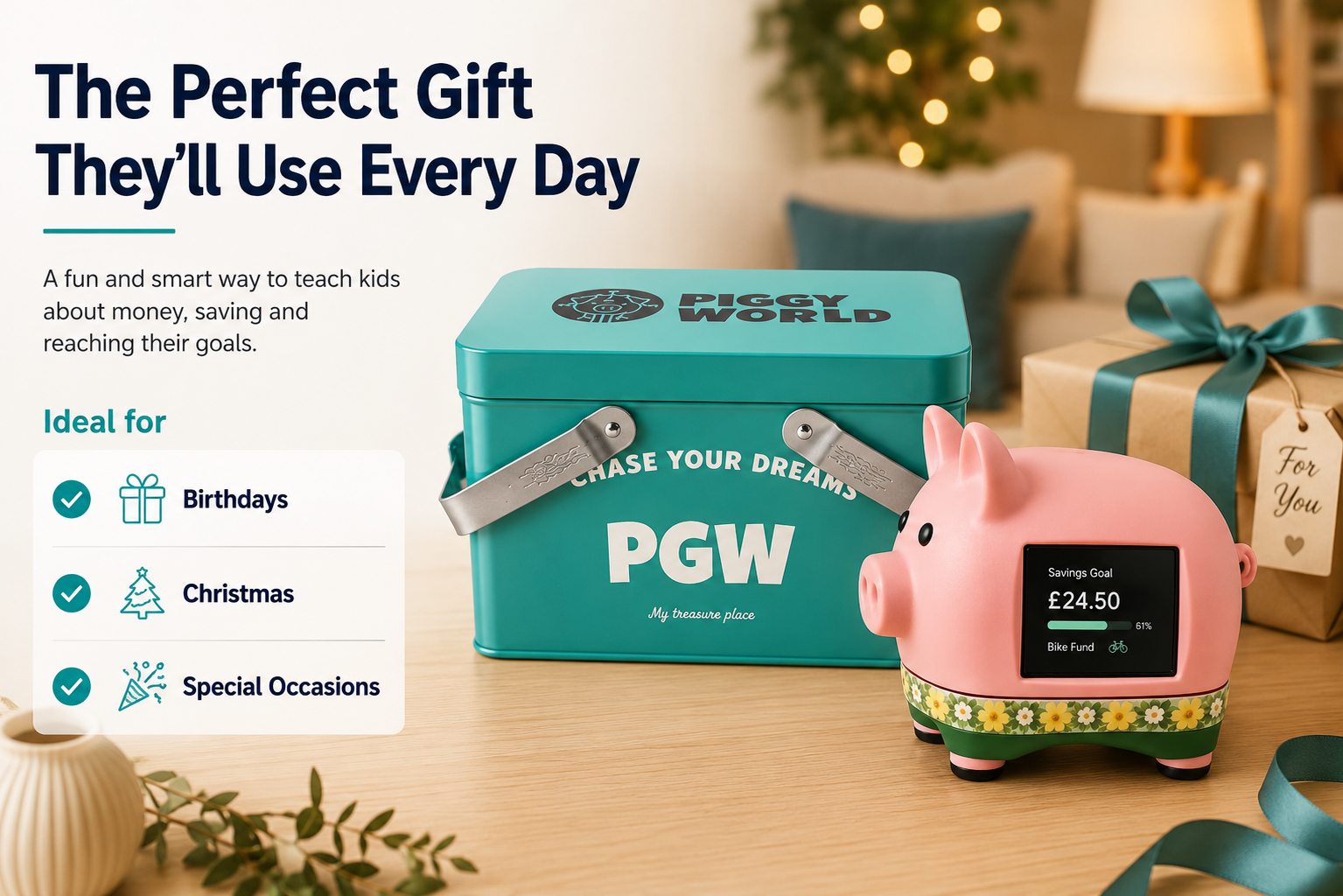
For generations, parents and grandparents have given children a piggy bank for birthdays, Christmas, christenings and other important occasions. It may contain a first coin, a little birthday money or the beginning of a child’s first savings goal.
The amount inside is often less important than what the gift represents.
A piggy bank introduces a child to a powerful idea: money does not always have to be spent immediately. It can be kept, counted and gradually turned into something meaningful.
That lesson remains just as important today. But childhood — and money — have changed.
Children now grow up in a world of contactless payments, digital purchases, gaming currencies and online subscriptions. They may see adults pay for almost everything without using a single coin. This makes money more convenient, but also less visible and sometimes more difficult for children to understand.
The traditional piggy bank still has emotional and educational value. However, it can now do more than simply collect loose change.
The modern piggy bank can help connect physical saving with digital money, personal goals, household responsibilities and everyday conversations between children and their families.
This is the story of why the piggy bank has survived for generations — and why it is ready to evolve.
Why Do We Give Children Piggy Banks?
A piggy bank is one of the first financial tools many children encounter.
Long before a child understands bank accounts, interest rates or household budgets, they can understand a much simpler process:
- I have some money.
- I can spend it now or keep it.
- If I keep adding to it, the amount grows.
- Eventually, I may have enough for something I really want.
That sequence introduces several important concepts without making them feel like a formal lesson.
A child begins to experience choice, patience, progress and reward. They also discover that reaching a larger goal may require giving up smaller, immediate purchases.
A conventional toy usually gives the child an experience immediately. A piggy bank is different: it gives them a reason to look forward.
This is what makes it such a meaningful educational gift. It does not simply tell children that saving is important. It gives them somewhere to begin.
A Childhood Tradition with a Long History
Money boxes have existed in different forms for centuries. Archaeological examples date back to the ancient world, while pig-shaped money containers have also been found in medieval Java.
The precise origin of the English expression “piggy bank” is less certain than many popular stories suggest. One familiar theory connects it with a type of clay supposedly known as pygg, although financial museums note that the true etymology is still debated.
What is clear is that early money boxes were often designed without an easy way to remove the coins. To access the savings, the owner sometimes had to break the container.
That inconvenience served a purpose: putting money in was easy, but taking it out required a deliberate decision.
The design created a physical barrier between the impulse to spend and the decision to save.
Over time, the ceramic pig became one of the most recognisable symbols of saving. Modern versions frequently include a removable plug or door, but the image of breaking open a full piggy bank remains part of popular culture.
It represents the moment when patience finally becomes a reward.
Why Is a Piggy Bank a Good Gift for a Child?
The best children’s gifts usually have more than one kind of value. They should be enjoyable when opened, but ideally they should remain useful after the excitement of the occasion has passed.
A piggy bank can achieve both.
It feels personal
A piggy bank can mark an important first:
- A child’s first savings
- Their first experience of pocket money
- Their first financial goal
- Their first opportunity to choose what to do with their own money
Parents, grandparents and relatives can make the gift more meaningful by placing the first coin or note inside and explaining what it represents.
It can grow with the child
A five-year-old might save for a small toy. An eight-year-old might work towards a bicycle, a game or a special day out. An older child may begin saving for something that requires several months of planning.
The object remains the same, but the lessons become more sophisticated.
It encourages participation
Saving is not something being done silently by an adult on the child’s behalf. The child can take part, make choices and see the result of those choices.
It can start family conversations
A piggy bank creates natural opportunities to discuss questions such as:
- What would you like to save for?
- How much does it cost?
- How much have you already saved?
- Would you prefer to buy something small now or continue towards your larger goal?
- Is there anything you would like to share or give to someone else?
These short, ordinary conversations can be more memorable than a formal explanation about money.
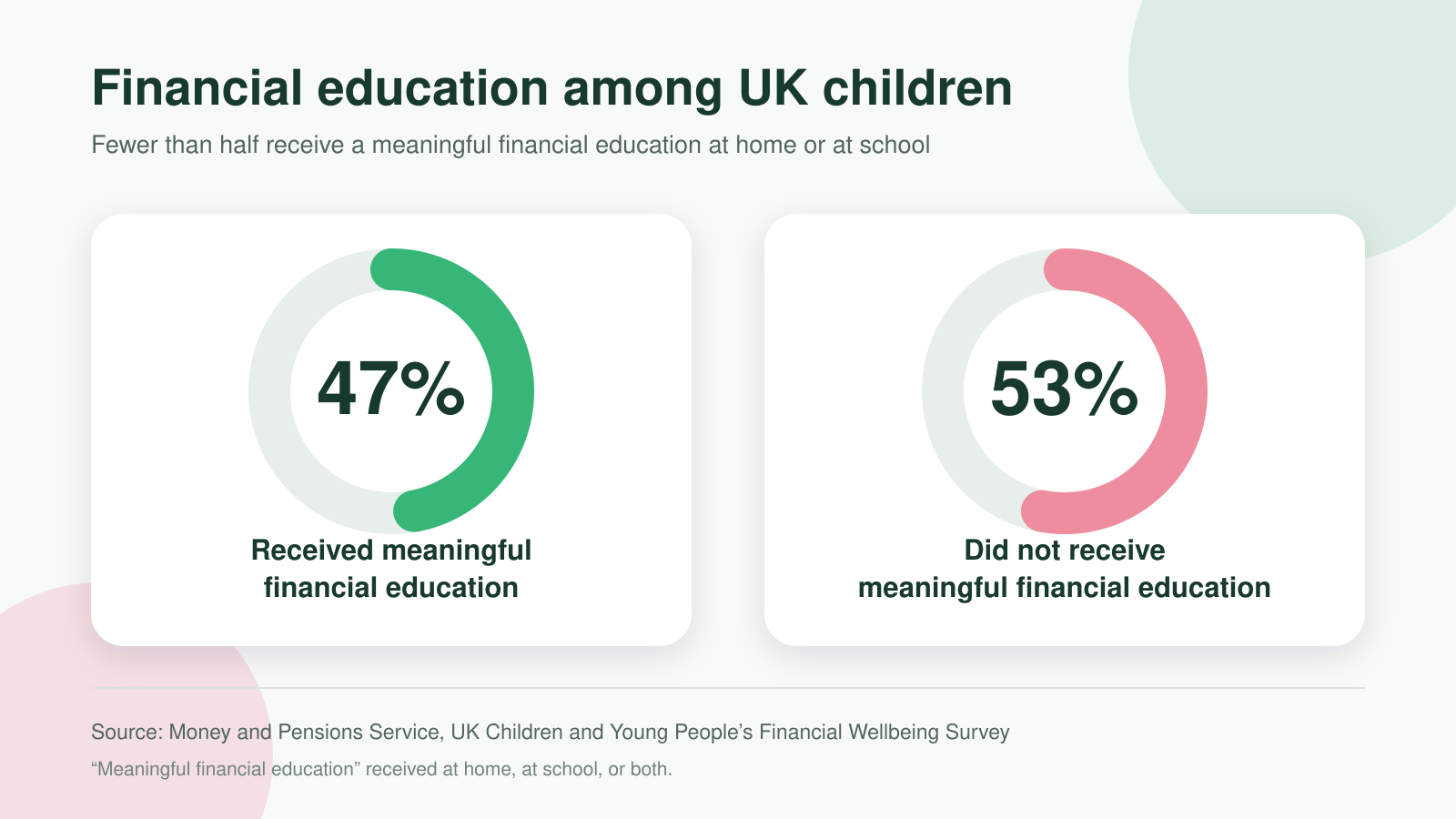
Research from the UK’s Money and Pensions Service found that only 47% of children and young people received a meaningful financial education at home or at school. Only 10% received meaningful financial education in both places. Children who did receive it were more likely to save actively, feel confident managing money and use a bank account.
A piggy bank cannot provide a complete financial education by itself. But it can give families an easy and familiar place to start.
Children Learn Money Habits Earlier Than Many Adults Realise
Parents sometimes assume that financial education can wait until a child becomes a teenager. By then, however, children may already have developed important attitudes towards saving, spending and delayed gratification.
A report on habit formation by researchers at the University of Cambridge found that, by approximately the age of seven, many children can already recognise the value of money, count it and understand that it can be exchanged for goods. They are also developing behaviours that may influence how they manage money later.
This does not mean that a child’s financial future is permanently decided at seven. It means the early years provide a valuable opportunity to establish positive experiences.
Children learn particularly well through:
- Repetition
- Observation
- Simple choices
- Real-life participation
- Encouragement from adults
- Visible consequences
Saving a small amount regularly incorporates all six.
The lesson is not necessarily about accumulating a large balance. It is about creating a repeatable pattern:
Choose a goal. Save a little. See the progress. Wait. Reach the goal.
That pattern can later be applied to larger and more complex financial decisions.
What Does a Traditional Piggy Bank Teach?
Traditional piggy banks are simple, and that simplicity is part of their appeal.
Saving starts with small amounts
A single coin may seem insignificant, but many small contributions create a visible result. Children can discover that progress does not have to happen all at once.
Money is limited
Once a coin has been spent, it cannot also remain in the piggy bank. This introduces the idea of trade-offs in a way children can understand.
Waiting can lead to a better reward
A child may be able to buy a small treat today or continue saving for something more important. Learning to wait is relevant far beyond money.
Goals make saving meaningful
“Save your money” is an abstract instruction. “Let’s save £20 for the book you want” gives the child a clear purpose and a finish line.
Repetition turns an idea into a habit
Using a piggy bank regularly helps make saving an action rather than merely a piece of advice.
These are valuable lessons, but the traditional design also has limitations.
Where the Traditional Piggy Bank Falls Short
A classic money box stores money effectively, but it cannot always explain what is happening.
Unless the piggy bank is transparent, a child may not know how much they have saved without emptying it and counting every coin. They cannot easily see how close they are to a target or how long reaching it might take.
More importantly, a traditional piggy bank usually sits apart from the rest of family life.
It does not connect saving with effort, responsibilities or decision-making. It cannot help a child remember a goal. It cannot show progress over time. It cannot explain digital money or help parents create a structured learning experience.
Some children enjoy adding coins at first but gradually lose interest because nothing appears to change.
There is also a wider issue. Physical cash now represents only one part of a child’s financial world.
A child might receive birthday money through a bank transfer. Parents may pay pocket money digitally. Games use virtual currencies, while online shops allow purchases to happen with a tap. If children only associate money with coins, they may struggle to understand transactions they cannot physically see.
The challenge is therefore not to abandon the traditional piggy bank. It is to preserve what works and extend what it can teach.
How Has the Piggy Bank Evolved?
Modern money boxes have taken several different forms.
Some count coins automatically. Others separate money into categories such as “save”, “spend” and “share”. Clear containers make progress visible, while electronic money boxes imitate an ATM or use a code to protect the contents.
Children’s banking apps have taken the idea further by introducing digital balances, prepaid cards, savings pots and parental controls.
Each innovation solves part of the problem, but it can also create a new gap.
A purely physical piggy bank may not reflect the digital world. A purely digital app may feel abstract to a young child and lose the emotional connection of having something tangible that belongs to them.
For children aged approximately five to twelve, the most natural evolution may be to combine both worlds:
- A recognisable physical piggy bank
- A clear savings goal
- Visual progress
- Age-appropriate technology
- Tasks and responsibilities
- Rewards that remain under parental control
- Family conversations about earning, saving and spending
The purpose of technology should not be to complicate a simple childhood tradition. It should make the learning behind it easier to see.
From Storing Coins to Building Habits
A modern piggy bank can represent more than the money saved inside it.
It can help children understand the relationship between effort and reward. For example, a family might agree on age-appropriate responsibilities and decide whether some of them earn pocket money or another form of recognition.
This distinction matters. Not every household task needs to be paid. Children can still have basic responsibilities simply because they are part of the family. Parents may then choose additional tasks that provide an opportunity to earn.
The important lesson is not that children should expect payment for everything they do. It is that money is connected with decisions, effort and priorities.
A well-designed system can help a child move through a complete learning cycle:
- Choose something worth saving for.
- Understand how much it costs.
- Complete agreed responsibilities.
- Receive a reward or add existing money.
- Follow the progress.
- Decide whether to keep saving or spend.
- Reflect on the choice afterwards.
That cycle teaches considerably more than dropping an occasional coin into a container.
Why Visible Progress Matters
Children often find distant goals difficult to imagine. “You are saving for later” may not feel meaningful when later could be weeks or months away.
Visible progress turns an abstract promise into something concrete.
A goal bar, milestone, calendar or character that changes over time can show that every small action contributes to a larger result. This gives the child feedback before the final reward arrives.
The same principle is used in reading charts, classroom reward systems and sports training. Progress itself becomes motivating.
However, the experience should not place children under pressure. The objective is not to turn family life into a competition or to make children anxious about money. Goals should be realistic, flexible and appropriate for the child’s age.
The most useful technology supports encouragement and conversation. It should never replace them.
Physical Money Still Matters in a Digital World
Digital money is now part of everyday life, but physical money can still be particularly helpful for younger children.
Coins allow children to touch, count, group and compare. They make quantity visible. Removing a coin to buy something also creates a clear physical consequence.
Digital tools offer different benefits. They can show an exact balance, record progress and help families manage money that never exists as cash.
Children need opportunities to understand both.
A modern piggy bank can act as a bridge between the tangible world children naturally understand and the digital financial environment they will eventually need to navigate.
The purpose is not to make a six-year-old behave like an adult banking customer. It is to introduce digital concepts gradually while keeping the experience playful, visible and family-led.
Introducing PiggyWorld: A Familiar Idea Reimagined
PiggyWorld begins with an object almost every family recognises: the piggy bank.
But rather than treating it only as a container for coins, PiggyWorld turns saving into an interactive experience designed for children and their families.
It brings together a physical piggy bank and a connected digital experience where children can work towards goals, develop routines, complete agreed tasks and follow their progress.
The child is not simply told to save. They are given a reason to return, participate and understand what their actions are achieving.
For parents, the aim is not to hand financial education over to a screen. It is to provide a structure for the small conversations and experiences through which children learn best.
PiggyWorld retains the emotional appeal of a childhood keepsake while responding to the world children now live in.
It is still a piggy bank.
It simply has more to teach.
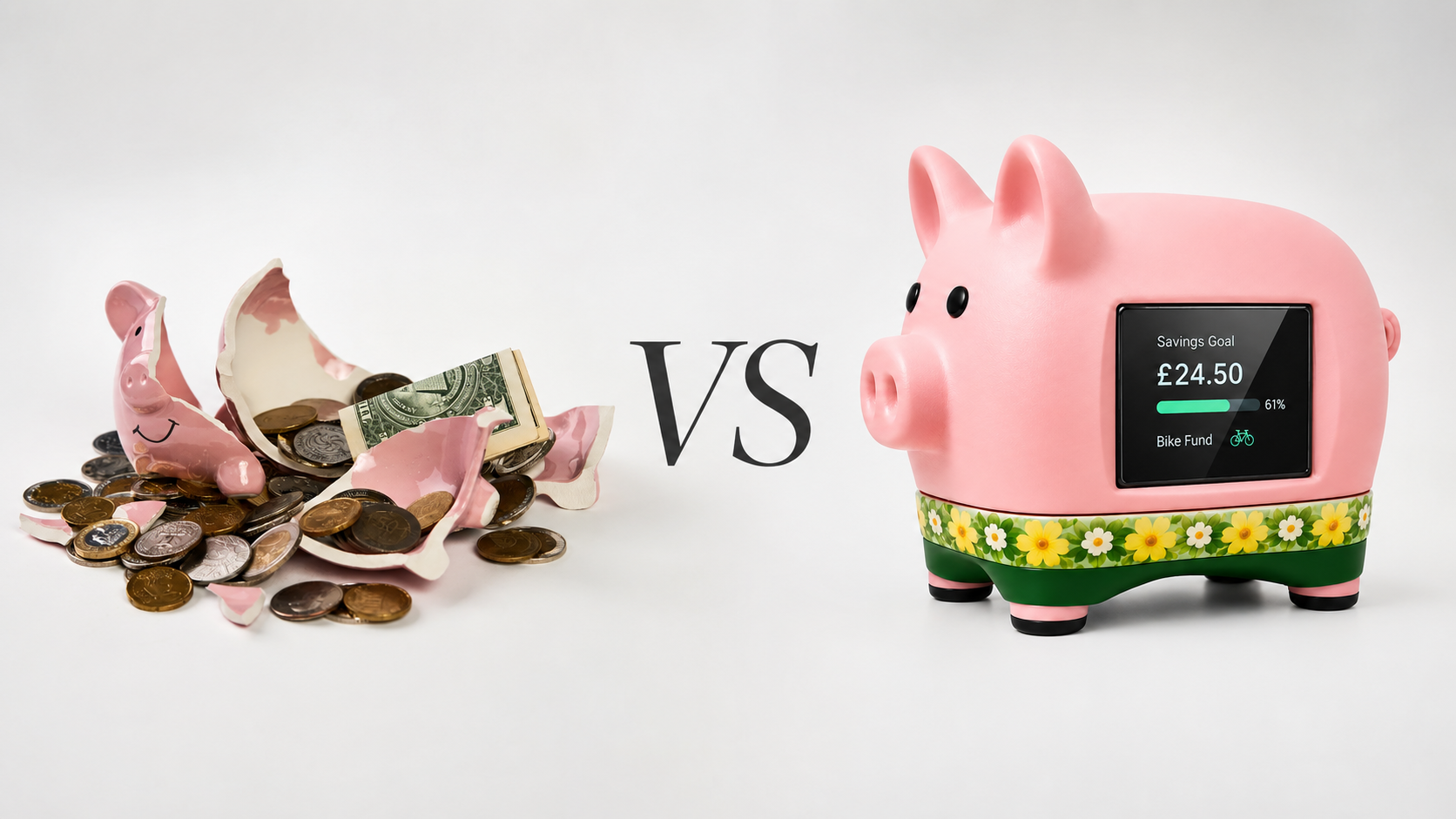
The Piggy Bank You’ll Never Have to Break
The line has a literal inspiration: the traditional image of saving coins until the ceramic pig is finally broken open.
But it also carries a more important meaning.
A good savings habit should not end when one goal is reached. The child should be able to celebrate the achievement, choose a new goal and continue learning.
The piggy bank does not need to represent one final moment of destruction. It can become an experience that grows with the child.
That is the real evolution:
- From one savings event to an ongoing habit
- From hidden coins to visible progress
- From passive storage to active learning
- From a solitary object to a shared family experience
- From the physical world alone to a careful bridge between physical and digital money
PiggyWorld is the piggy bank you’ll never have to break — because reaching one goal is only the beginning of the next.
How to Use a Piggy Bank to Teach Healthy Money Habits
Whichever type of piggy bank a family chooses, the way it is used matters more than the amount saved.
Let the child choose a goal
Children are more motivated when the goal belongs to them. Parents can guide the choice without controlling every decision.
Make the target achievable
A first goal should be close enough for the child to experience success. A very expensive target may make progress feel impossible.
Save regularly
Small, consistent contributions are more educational than a single large deposit. Regular saving helps children understand how habits produce results.
Talk about choices without judgement
Children will sometimes spend money on something adults consider unnecessary. A safe, small mistake can become a valuable lesson.
Rather than immediately saying, “I told you so”, parents can ask:
- Are you happy with what you bought?
- Was it worth the amount you paid?
- Would you make the same choice again?
- What might you do differently next time?
Celebrate progress, not just completion
Waiting until the full target is reached can make the journey feel long. Recognising milestones helps sustain motivation.
Begin a new goal
Once the child uses their savings, help them reflect on the experience and decide what they would like to work towards next.
What Age Should a Child Receive Their First Piggy Bank?
There is no single correct age.
Many children can begin exploring coins and the idea of saving from around three to five years old, provided that small objects are handled safely and with adult supervision.
Between five and seven, children can begin counting money, making simple choices and saving towards short-term goals.
Between eight and ten, they may be ready to compare prices, divide money between different purposes and plan for more expensive goals.
By eleven or twelve, conversations can gradually expand to digital payments, bank accounts, interest, advertising, online spending and the difference between wants and needs.
The learning should develop with the child. A piggy bank that remains engaging and adaptable has more long-term value than one designed only as a nursery decoration.
Frequently Asked Questions
Do piggy banks really help children save money?
A piggy bank can make saving visible and give children a specific place to keep money. Its educational value increases when adults combine it with regular contributions, achievable goals and conversations about choices.
Is a piggy bank an educational gift?
Yes. Although it is simple, a piggy bank can introduce saving, counting, patience, goal-setting and delayed gratification. Modern versions may also help children understand tasks, rewards and digital money.
Are piggy banks suitable for five-year-olds?
They can be, with appropriate adult supervision. At this age, goals should be simple, visual and achievable. Adults should also consider the safety of loose coins and small components.
Should children receive pocket money for household tasks?
There is no universal rule. Some families provide regular pocket money separately from household responsibilities. Others offer rewards for selected additional tasks. The most important consideration is that expectations are clear and appropriate for the child.
Are digital savings tools better than traditional piggy banks?
They teach different things. Physical money can help younger children understand quantity, while digital tools can make balances and progress easier to follow. A combination of physical and digital experiences may provide the most complete introduction.
Do children still need piggy banks when most payments are digital?
The decline of cash makes financial education more important, not less. A piggy bank provides a recognisable starting point, while modern tools can help children connect physical saving with the digital transactions they see around them.
A Traditional Gift for a New Generation
The piggy bank has lasted because its central lesson is timeless.
Small amounts matter. Waiting can be worthwhile. Goals require choices. Progress happens gradually.
Those ideas were relevant when children saved only coins, and they remain relevant in a world of contactless cards, apps and virtual purchases.
The piggy bank does not need to disappear. It needs to evolve with the children who use it.
A traditional version can still begin a valuable conversation. A modern piggy bank can take that conversation further by making progress visible, connecting saving with everyday responsibilities and helping families turn occasional lessons into repeatable habits.
The best gifts do more than create excitement when they are opened. They continue giving something valuable long afterwards.
Sometimes, that gift is not simply the money placed inside a piggy bank.
It is the habit the child begins to build.
PiggyWorld. The piggy bank you’ll never have to break.