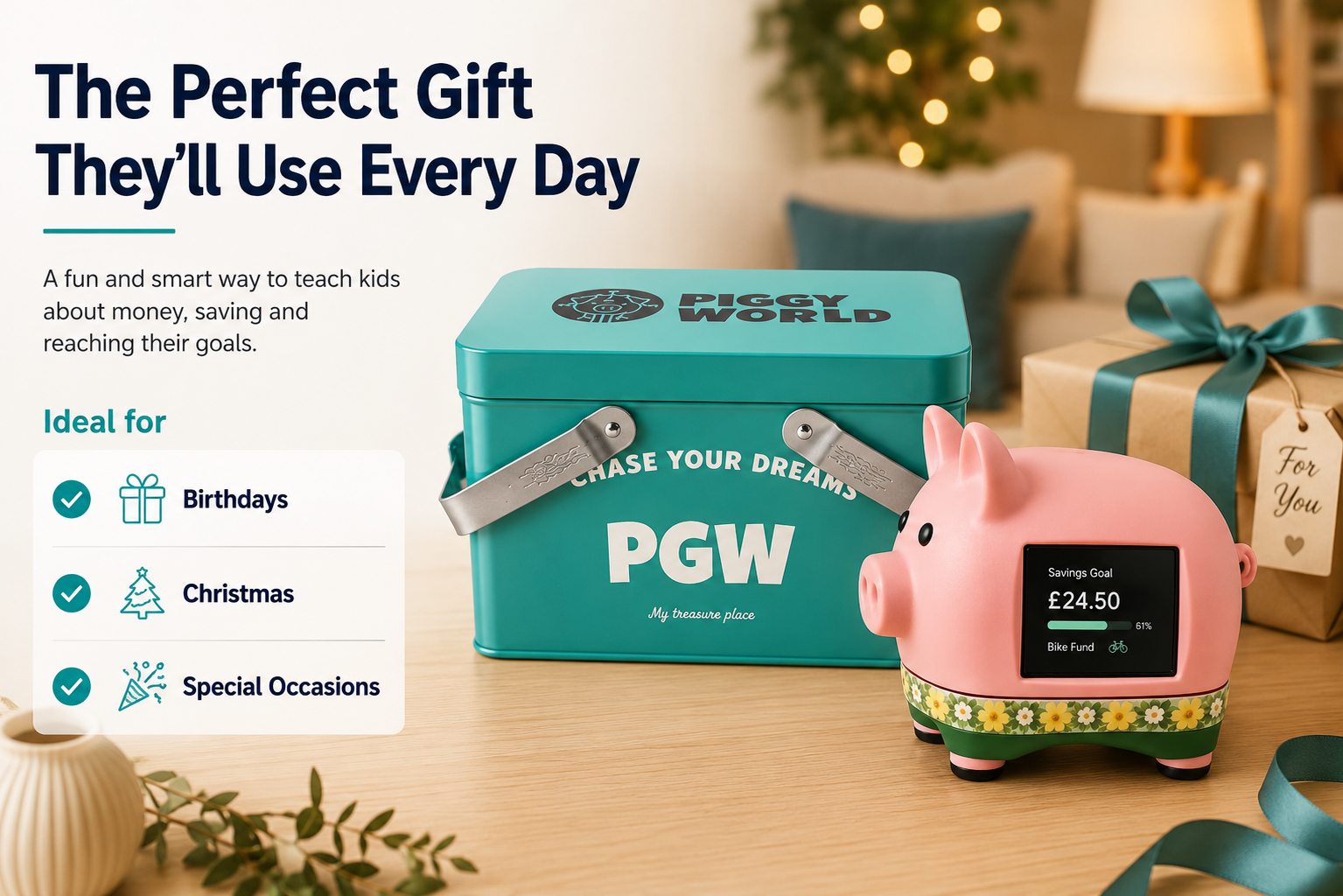
For generations, a piggy bank gave children one of their first lessons about money. Put a coin in, watch the money accumulate and eventually decide whether to keep saving or spend it. The lesson was simple because the money was physical: children could see it, touch it and understand that there was a limited amount available.
But childhood is changing. Children increasingly see adults pay with cards, phones and watches. Pocket money can arrive digitally. A bank balance is a number on a screen rather than a collection of coins. Money has not disappeared, but much of the physical evidence of it has.
That is the problem a smart piggy bank is designed to address.
A smart piggy bank is a physical saving or money-learning device that uses digital technology to help a child see, track or interact with money and saving. More advanced smart piggy banks can connect to an app, display a digital balance, support savings goals or rewards, and give parents a way to guide the experience.
In other words, it keeps something valuable about the traditional piggy bank — a visible object in the child’s world — while adding tools that reflect how money works today.
This guide explains what smart piggy banks are, how they work, how they differ from digital money boxes and children’s banking apps, what they can realistically teach, and what parents should look for before choosing one.
Why piggy banks still matter in a digital world
The traditional piggy bank has survived for a reason: it turns an abstract idea into something concrete.
For a young child, “saving” is difficult to understand in the abstract. A physical money box creates a simple sequence:
- I have some money.
- I choose not to spend it now.
- I put it somewhere safe.
- The amount grows over time.
- Eventually, I can use it for something I value.
Those are surprisingly important ideas.
MoneyHelper, the consumer guidance service provided by the Money and Pensions Service (MaPS), describes piggy banks as useful for very young children because they help introduce the ideas of keeping money safe, recognising its value, saving for something they want and making choices. Its guidance also makes an important point: the amount of pocket money matters less than the practice of managing it.
The difficulty is that the environment in which children learn those lessons is becoming less physical.
The Bank of England has specifically identified declining cash use as a challenge for children’s financial education because cash has traditionally played a role in some of their earliest experiences with money, including piggy banks and pocket money.
MoneyHelper’s guidance on digital money highlights the same problem from a parent’s perspective: when children see an adult tap a card or phone, it can be difficult for them to understand that real money has still been spent.
This creates a modern educational gap.
Traditional piggy banks make money tangible, but do not naturally represent digital balances. Banking apps represent digital money accurately, but can make the learning experience live almost entirely on a screen.
A well-designed smart piggy bank sits between those two worlds.
What exactly makes a piggy bank “smart”?
There is no official or regulated technical definition of a smart piggy bank. The term is currently used for products with very different capabilities, which is why parents can encounter confusing search results.
Some products described as “smart” are simply electronic money boxes with a PIN keypad. Others count coins automatically. Some are apps with no physical piggy bank at all. At the more advanced end are physical devices that interact with an app or a digital balance.
A useful way to distinguish them is by what the technology actually does.
Traditional piggy bank
A physical object used to store cash and encourage saving. It has no digital features or connected app.
Electronic or digital money box
A physical money box that adds features such as a counter, display, sounds or PIN. It makes storing or counting cash more interactive, but is usually not connected to an app or account.
Digital piggy bank app
A software-based solution with no physical piggy bank. It allows children and parents to track virtual pocket money, savings and goals digitally.
Smart piggy bank
A physical money-learning object enhanced by digital technology. It can connect physical interaction with digital money, saving goals, rewards and progress, often through an app or connected account.
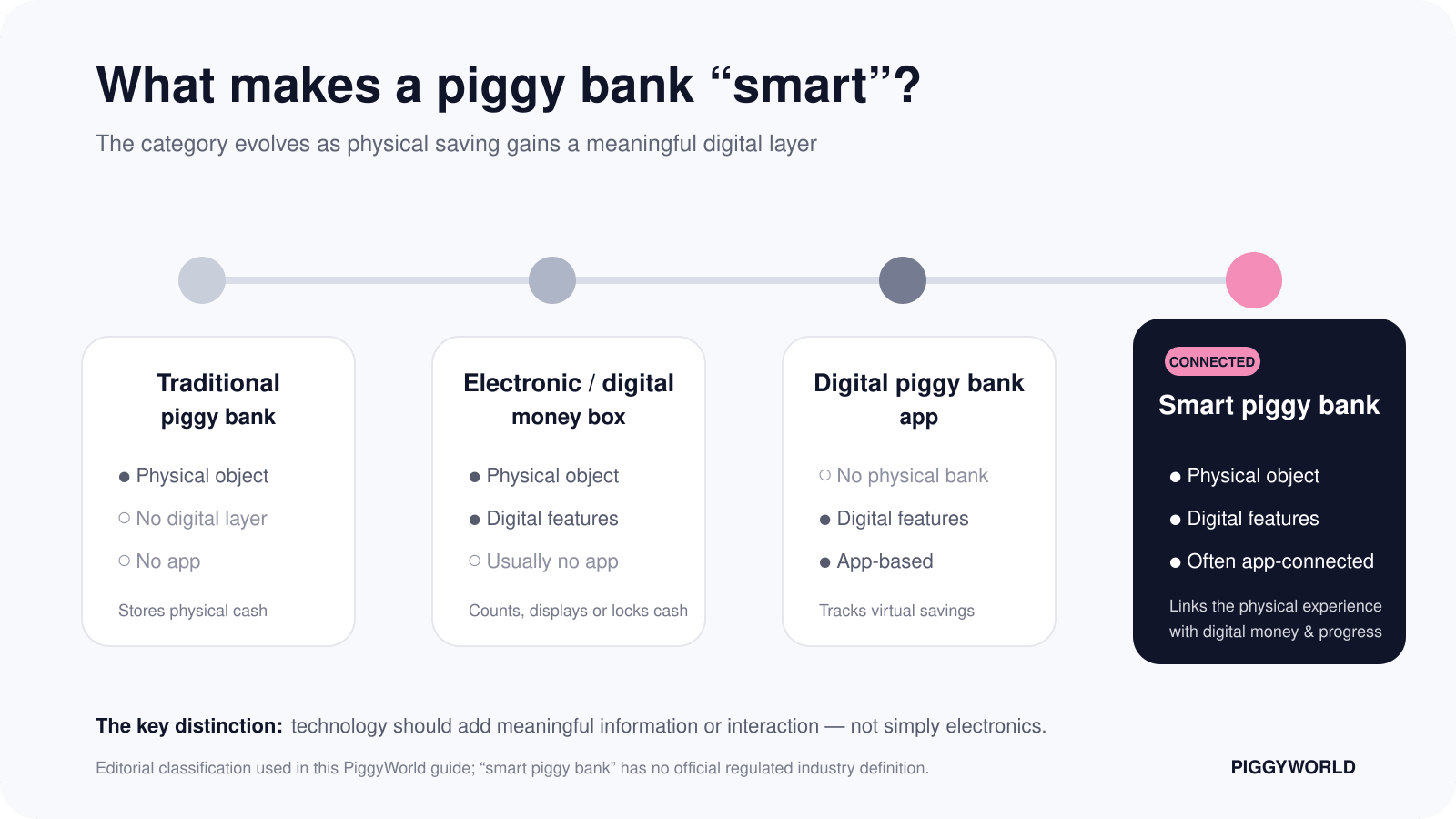
The important difference is not whether a product contains electronics. It is whether the technology adds meaningful information or interaction to the child’s experience of money.
A password-protected cash box can be fun, but a keypad alone does not necessarily teach a child what a balance means, why it changed or what they are working towards. Similarly, a coin-counting jar can help make a cash total visible but does not automatically connect that total to wider financial habits.
For parents choosing a smart piggy bank, the better question is therefore not “How many features does it have?” but “What money behaviour does each feature help my child practise?”
How does a smart piggy bank work?
There is no single design, but most smart piggy banks combine two or more layers.
1. A physical anchor
The first layer is the object itself. It sits in the child’s room or home and gives money a physical presence.
That matters particularly when the balance it represents is digital. A child may not physically hold every pound, but there is still something in their environment associated with their progress.
2. A digital balance or display
Some smart piggy banks display an amount saved, earned or available. Others reveal this information through an interaction with a connected phone or app.
The aim is to make an otherwise invisible balance easier for the child to understand.
3. An app or parent layer
Connected products may give parents an app through which they can manage pocket money, set goals, create tasks or supervise rewards. The child’s experience can remain centred on the physical piggy bank while more complex controls stay with the parent.
4. Goals, tasks or rewards
More education-focused systems go beyond displaying a number. They may allow a child to work towards a savings target, earn money by completing agreed tasks, or see how repeated actions affect progress.
This is where a smart piggy bank can become more than a modern container for money. It can become a tool for practising decisions and habits.
5. A connection to real money
Not all smart piggy banks connect to real money. Some track an amount that the parent records manually; others can interact with a banking or payment layer.
Parents should understand this distinction before buying. A displayed “£20” may represent physical cash in the device, a parent-maintained virtual ledger or actual money held elsewhere. Those are not the same thing.
Smart piggy bank vs digital piggy bank: what is the difference?
The terms are often used interchangeably online, but they are useful for describing different experiences.
A digital piggy bank can refer to a digital money box or to an app that tracks savings without any physical bank. Its defining characteristic is that some part of the saving experience is digitised.
A smart piggy bank, in the sense used in this guide, retains a physical object and uses connected or interactive technology to add a digital layer to it.
That physical-digital combination is important because it can preserve some of the tangibility of a traditional piggy bank while helping children understand balances that may no longer exist as coins in a jar.
The terminology is still evolving, so parents should always judge the actual features rather than the product label.
Smart piggy bank vs children’s money app
A children’s pocket-money or finance app can be an excellent tool. It can show balances, record transactions, divide money into saving and spending categories and, depending on the service, connect to a card or account.
The key difference is the interface through which the child encounters money.
With an app-only product, the experience primarily takes place on a phone or tablet. With a smart piggy bank, the child also has a dedicated physical object associated with saving or progress.
Neither approach is automatically better. They solve slightly different problems.
An app can be particularly suitable for an older child who is already using a phone and beginning to manage spending independently. A smart piggy bank may be useful when parents want to introduce digital money concepts while retaining a tangible, child-friendly object in the home.
For some families, the two approaches can complement each other rather than compete.
Smart piggy bank vs children’s debit card
A children’s debit or prepaid card is mainly a spending and money-management tool. It gives a child experience with transactions in the outside world and can help them learn to monitor a balance.
A smart piggy bank is primarily a learning and saving interface. Depending on the product, it can focus on earning, waiting, saving, goal-setting or understanding how a balance changes.
The distinction matters because spending money and learning about money are related, but they are not identical.
A child may learn how to tap a card very quickly. The deeper lessons are why money is limited, how it is earned, what happens after it is spent, why saving requires waiting, and how small choices add up over time.
A good financial education gives children opportunities to practise both.
What can a smart piggy bank teach a child?
A smart piggy bank does not teach financial literacy by itself. No device can replace conversations, examples and guidance from parents or carers.
But a well-designed one can create repeated opportunities for those lessons to happen.
The value of money
When money appears only as a payment card or a number on a parent’s phone, it can seem unlimited. Connecting a visible balance to real choices helps show that money is finite.
The relationship between effort and reward
Some families choose to link certain household tasks or goals to pocket money or rewards. This is a personal parenting decision — not every household pays for chores — but when parents do use rewards, a smart system can make the connection between an agreed action and its outcome clearer.
Saving and delayed gratification
A savings goal turns “don’t spend it” into something more meaningful: “I’m choosing this future goal instead.” Seeing progress towards a target can make waiting easier to understand.
Making choices
Financial capability is not simply knowing what money is. It involves deciding what to do with a limited amount.
The Money and Pensions Service’s UK research found that children who were involved in, or made, decisions about spending performed better across a range of financial capability measures. Its guidance emphasises opportunities to handle and manage money rather than education being confined to theory.
Understanding digital money
Perhaps the most distinctive role of a smart piggy bank is making digital money less abstract. When a balance changes after earning, saving or spending, the child can begin to connect the number with an event in the real world.
Building routines
Money habits are rarely formed in one lesson. A regular pocket-money day, a weekly savings decision or progress towards a goal creates repetition. Technology can support that routine, but the routine itself is where much of the learning happens.
Do children really need financial education this early?
Financial education is not about burdening young children with mortgages, debt or adult financial anxiety. At primary-school age it can be much simpler: recognising that money is limited, making choices, understanding saving, distinguishing needs from wants and learning that digital payments still involve real money.
The UK evidence strongly supports giving children meaningful opportunities to learn.
In the 2022 UK Children and Young People’s Financial Wellbeing Survey, based on a nationally representative sample of 4,740 children and young people aged 7–17, only 47% were assessed as having received a meaningful financial education. The survey also found that 88% said they would ask their parents for money advice, while only just over half of parents and carers said they felt confident talking to their children about money.
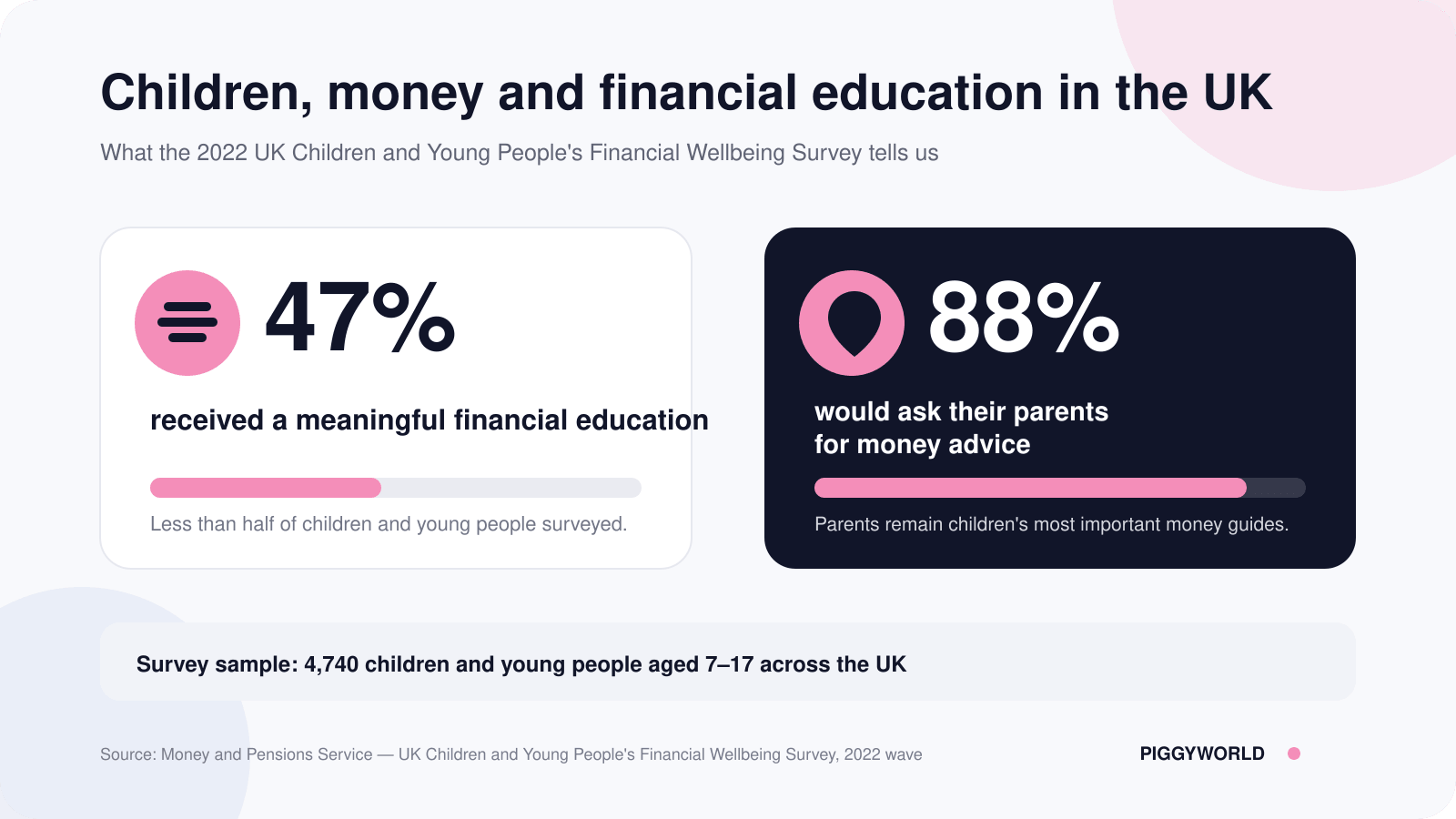
Children who had received a meaningful financial education were more likely to report positive outcomes including greater confidence around money, more regular saving and money-management skills. The survey shows associations rather than proving that any single activity or product caused those outcomes, but it underlines the importance of the learning environment around a child.
The national ambition reflects this. The UK Strategy for Financial Wellbeing set a goal for two million more children and young people to receive a meaningful financial education by 2030.
And in England, the Government’s Financial Inclusion Strategy commits to making financial education compulsory in primary schools as part of a new statutory requirement for Citizenship. At the time of writing, this represents a government commitment and curriculum reform rather than something parents should assume is already fully in force in every primary classroom.
School matters. But home matters too.
MaPS research found that 88% of children and young people would turn to parents for money advice. Everyday family experiences — saving for something, comparing prices, deciding whether to spend now or later — can give financial ideas a meaning that a worksheet alone cannot.
What age is a smart piggy bank suitable for?
There is no universal age because smart piggy banks vary widely, and children develop at different rates.
As a broad guide, the learning can evolve with the child:
Around ages 4–6: make money visible
Keep concepts simple. Introduce coins and notes, explain that paying digitally still uses real money, and use small goals that a child can understand.
At this stage, the parent should lead the experience.
Around ages 7–10: introduce choices and goals
Children can begin to take more ownership of a small regular amount of money. This is a useful time to introduce saving goals, simple spending decisions and the idea that choosing one thing can mean giving up another.
Around ages 11–14: add independence and digital context
Older children can understand more detailed balances, budgeting and the link between saving and spending. A smart piggy bank can sit alongside a bank account, card or app rather than replacing them.
The right question is less “Is my child old enough for the technology?” and more “Does this product present the money concepts in a way my child can understand?”
Are smart piggy banks safe?
Safety depends on the product. A simple electronic coin counter and an app-connected device do not create the same risks.
Parents should consider both physical safety and digital safety.
For connected products, check what information is collected, whether an account is required, who controls the device, how the child’s data is used and whether the service contains advertising or unnecessary social features.
In the UK, children have specific data-protection safeguards. The Information Commissioner’s Office Children’s Code applies to online services likely to be accessed by children and includes apps and connected toys or devices. Among its principles are putting the child’s best interests first, high privacy by default and minimising collection and retention of personal data.
For products involving banking or payments, parents should also understand where the money is actually held and who provides the financial service. A smart piggy bank may display or interact with a balance without itself being a bank or holding customer funds.
Finally, parental controls should not simply exist — they should be understandable. Parents should be able to see what they are approving, change settings and explain to the child what is happening.
What should parents look for in a smart piggy bank?
The best smart piggy bank is not necessarily the one with the longest feature list. Look for a clear educational purpose.
1. A balance the child can understand
If the aim is to make digital money tangible, the child should be able to see progress without navigating a complicated adult interface.
2. Meaningful goals
Saving towards a book, toy, experience or longer-term target gives the balance a purpose. Look for goals that can be made concrete and personal.
3. Parent involvement without parent domination
Parents need oversight, especially for younger children. But a good learning tool should gradually give the child appropriate responsibility rather than making every decision invisible to them.
4. Clear separation between learning and spending
Gamification can make learning engaging, but children should not be encouraged to spend simply to keep using the product. Rewards, streaks or animations should support healthy behaviour rather than manipulate attention.
5. Privacy and security designed for children
Read the privacy information. Check the default settings. Ask whether the service needs every piece of information it requests. Connected children’s products deserve a higher level of scrutiny, not a lower one because they look playful.
6. A system that reflects real money
Children need to understand what a displayed balance represents. If real money is involved, the product should clearly explain the relationship between the device, app, parent and any account or payment provider.
7. Room to grow
A five-year-old and a thirteen-year-old need different lessons. Products that can evolve from basic saving to goals, decisions and greater independence may remain useful for longer.
A real example: how PiggyWorld approaches the smart piggy bank
PiggyWorld was created around the physical-digital gap described in this guide.
PiggyWorld is a smart piggy bank and financial education app for children that connects everyday tasks, real rewards, saving and a visible balance under parental control.
Parents use the app to create small daily tasks or challenges and decide what each completed task is worth. The parent validates completion, and the child can see the resulting balance through the Piggy. Savings goals and progress are designed to connect the number on the screen with something the child has done or is working towards.
The important idea is not simply that a piggy bank has become electronic. It is that the physical Piggy provides a child-friendly point of contact with money while the parent manages the more complex digital layer.
That illustrates the broader direction of the category: the smart piggy bank is not trying to make the traditional piggy bank obsolete. It is trying to preserve the visibility and emotional connection of a physical object while adapting the learning experience to digital money.
Does a smart piggy bank replace cash?
It should not need to.
Cash still has educational advantages. Children can count coins, compare denominations and physically see an amount shrink when they spend it. The Bank of England also continues to recognise cash as an important payment method and does not expect it simply to disappear.
But children also need to understand the forms of money they will encounter in everyday life.
The strongest approach is not “cash versus digital”. It is helping a child understand that both represent value.
A £5 note, £5 shown in a bank account and £5 represented through a smart piggy bank may look different, but the underlying lesson is the same: there is a finite amount of money, and using it involves a choice.
Parents can reinforce that link very simply. When paying by card, say what the purchase costs and explain that the account balance will be lower afterwards. When a child receives digital pocket money, connect it to a visible savings goal. When they use cash, let them count what remains.
Financial understanding becomes stronger when the digital and physical worlds explain each other.
What is the future of the piggy bank?
The piggy bank has always been a teaching interface as much as a container.
Its original power came from making saving visible. The next generation can preserve that idea while changing what “visible” means.
Future smart piggy banks are likely to do more than count coins. They can potentially connect physical objects with digital balances, goals, family routines and age-appropriate financial learning. The most useful innovations will not be those that add technology for its own sake, but those that make increasingly invisible money easier for children to understand.
That distinction matters.
A child does not become financially capable because a device flashes, talks or connects to Wi-Fi. They learn through repeated experience: earning or receiving a limited amount, making choices, saving towards something, sometimes making mistakes, and talking about those decisions with a trusted adult.
Technology is valuable when it makes those experiences clearer.
The traditional piggy bank taught children to see their coins accumulate. The smart piggy bank has the opportunity to do the same for a generation growing up with digital money.
Frequently asked questions about smart piggy banks
What is a smart piggy bank?
A smart piggy bank is a physical saving or financial-learning device that uses digital technology to help a child see, track or interact with money. Depending on the product, it may display a balance, connect to an app, support savings goals, track rewards or interact with real money held elsewhere.
What is the difference between a smart piggy bank and a digital piggy bank?
“Digital piggy bank” is a broad term that can describe an electronic money box or even an app with no physical product. A smart piggy bank generally combines a physical object with digital or connected features. Because there is no official industry definition, parents should compare the actual functions rather than relying on the label.
Is a smart piggy bank the same as a kids’ banking app?
No. A banking or pocket-money app primarily provides a digital interface, sometimes with a card or account. A smart piggy bank retains a physical object that acts as part of the child’s saving or learning experience. Some families may use both.
Can a smart piggy bank hold real money?
It depends on the product. Some physically store cash, some track virtual amounts, and some interact with money held in a separate account. Parents should check exactly what a displayed balance represents and where any real funds are held.
Can a smart piggy bank teach financial literacy?
It can support financial learning, but it is not a substitute for parental guidance or broader financial education. Its value comes from giving children repeated, age-appropriate opportunities to see balances, save towards goals, make choices and talk about money.
Are smart piggy banks safe for children?
Safety varies by product. For connected devices, parents should review privacy, security, parental controls, data collection and any banking or payment relationships. In the UK, online services likely to be accessed by children are expected to follow the data-protection standards set out in the ICO Children’s Code.
What age is best for a smart piggy bank?
There is no single age. Younger children may use one with close parental support to understand simple saving and rewards, while older children can take more responsibility for goals and money decisions. Always follow the product’s stated age guidance and consider the individual child’s understanding.
Do smart piggy banks still make sense if we use cash at home?
Yes. Cash and digital learning can complement each other. Handling coins can make money concrete, while a smart piggy bank can help explain digital balances and goals. Children increasingly need to understand both.
The bottom line
A smart piggy bank is best understood not as a gadget, but as an evolution of a very old learning tool.
The traditional piggy bank made saving visible when money was mostly physical. A modern smart piggy bank can help preserve that visibility when money is increasingly digital.
For parents, the technology itself should never be the deciding factor. Look for a product that makes money clearer, encourages healthy choices, respects children’s privacy, gives parents appropriate oversight and creates opportunities to talk and learn together.
Because the real goal is not to raise a child who knows how to use a piggy bank.
It is to raise a child who understands what money means when the piggy bank is no longer needed.
Continue learning
If you would like to explore the ideas behind smart piggy banks in more depth, read:
- Cash vs Digital Money for Children: Which Helps Them Learn Better?
- How to Teach Kids About Money
- How Much Pocket Money Should You Give Your Child?
- What Is Financial Literacy for Children?
To see how PiggyWorld combines a physical smart piggy bank with a parent-controlled financial education app, discover PiggyWorld.
Editorial sources
- Bank of England — Financial education in a digital world
- MoneyHelper — Explaining digital money to children
- MoneyHelper — Saving for your children
- MoneyHelper — Pocket money and saving
- Money and Pensions Service / FinCap — UK Children and Young People’s Financial Wellbeing Survey
- Money and Pensions Service — UK Strategy for Financial Wellbeing 2020–2030
- HM Government — Financial Inclusion Strategy
- Information Commissioner’s Office — Age appropriate design: a code of practice for online services
- Bank of England — Will cash die out?
Editorial note
This article distinguishes between traditional, electronic/digital, app-only and smart piggy banks to help parents navigate inconsistent terminology in the current market. There is no official industry or regulatory definition of “smart piggy bank”; the definition used here is descriptive rather than a regulated product classification.